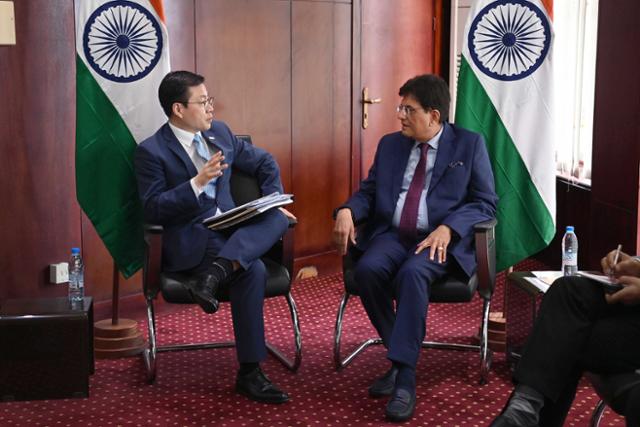

Lee Jae-myung and To Lam oversaw the signing of memorandums of understanding between South Korea and Vietnam to expand cooperation in power infrastructure and water security, South Korea’s environment ministry said.
Under the agreements, South Korea’s climate and environment ministry and Vietnam’s Ministry of Industry and Trade will work together to strengthen electricity supply through policy and technology coordination, share information on grid operations, and advance smart-grid systems and power-asset management. The two sides also agreed to collaborate on power-generation projects, including renewable energy and battery energy storage systems.
Vietnam, one of Asia’s fastest-growing economies with annual growth of about 6% to 7%, is seeking to meet rapidly rising electricity demand. Under its eighth national power development plan, the country aims to expand total generation capacity to nearly three times current levels by 2030. It plans to invest about $136.3 billion in power infrastructure by that year, including expanding transmission networks and increasing the share of renewable energy.
South Korea’s ministry said the two countries have similar electricity market structures centered on state utilities, creating opportunities for broader cooperation involving Korea Electric Power Corp., the Korea Power Exchange, independent power producers and renewable-energy companies.
Separately, South Korea’s ministry and Vietnam’s agriculture and environment ministry agreed to deepen cooperation in water management, including integrated water-resource management, freshwater ecosystem restoration, carbon-neutral initiatives in the water sector and cross-border water governance.
The agreement upgrades an earlier director-level arrangement signed two years ago to the ministerial level. The two sides plan to establish a joint working group, including private-sector participants, to oversee projects.
Vietnam currently has water supply coverage of about 85%, while sewage infrastructure remains underdeveloped at roughly 10%. The country aims to reduce water loss rates to around 10% and raise urban wastewater treatment to 30% by 2030, requiring increased investment in water infrastructure.
Officials said Vietnam’s push to attract semiconductor investment is driving a sharp increase in water demand. The government is also increasing spending to mitigate urban flooding and is seeking private capital and technology to upgrade wastewater systems.
The agreements followed the 17th Korea-Vietnam Environment Ministers’ Meeting, where additional cooperation deals were signed. South Korea’s Mekong Water Management Center and the Vietnam Mekong Committee agreed to collaborate on sustainable water-resource management in the Mekong region.
The Mekong River, Southeast Asia’s longest river, flows from the Tibetan Plateau through Myanmar, Laos, Thailand, Cambodia and Vietnam before emptying into the South China Sea.
In separate industry agreements, South Korea’s Samjin E&I and Vietnam’s state-run industrial park developer Becamex agreed to cooperate on industrial water supply, wastewater treatment technologies, smart water-management platforms using information and communication technology, and biogas production from organic waste.
Meanwhile, the Korea Environmental Industry & Technology Institute and Vietnam’s agriculture and environment ministry agreed to develop national standards for alternative fuels derived from waste, as demand rises amid higher prices for conventional fuels such as coal.