Orion, a South Korean food company that makes packaged snacks, is nearing $720 million in annual potato snack sales after spending almost four decades on a part of the business consumers never see. The company develops potato varieties, contracts directly with growers and manages sourcing networks across South Korea, China and Vietnam.
The strategy matters beyond Korea because it shows how a consumer brand can use crop genetics to gain greater control over raw material quality and supply before a product reaches a factory. The approach puts Orion in a small group with PepsiCo, the American food and beverage company behind Lay’s, and Calbee, a major Japanese snack maker. Orion says the three are the only snack companies worldwide that directly develop potato varieties for their products.
The financial significance lies in Orion’s overseas business. The company generated $630 million from potato snacks last year, and markets outside South Korea accounted for 73% of the total. Its seed program is therefore more than a domestic agricultural project. It has become the operating foundation of a regional food business spanning three Asian markets.
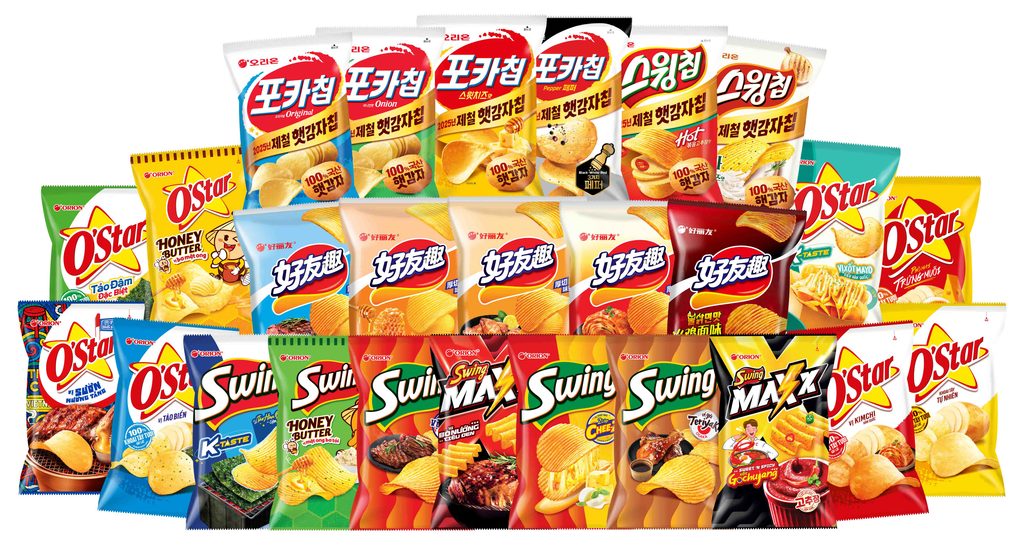
Orion uses about 230,000 metric tons of potatoes each year across South Korea, China and Vietnam. It sells roughly 70 potato snack products under six brands, including Poca Chip, Oh Potato, Swing Chip and Yegam.
Four of Orion’s nine brands with annual sales exceeding $70 million are potato snacks. The concentration shows how one agricultural ingredient has become central to the company’s growth beyond its home market.
Orion began building that system in 1988, when it became the first private company in South Korea to establish a research institute dedicated to potatoes. Rather than relying entirely on varieties available from outside suppliers, the company began developing potatoes specifically for snack production.
The investment reflects a simple manufacturing problem. A potato that performs well as a general food crop may not necessarily deliver the shape, texture, color or consistency required for mass produced chips. Developing varieties for a specific product allows a manufacturer to connect agricultural research more closely with factory output.
Orion developed its Dubaek variety in 2000, followed by Jinseo in 2023 and Jeonggam in 2024. Dubaek has been distributed to South Korean farms since 2020 through a partnership with a provincial potato seed agency in Gangwon.
The company says Dubaek now accounts for 90% of South Korea’s summer potato production. Its expansion has also given participating farmers access to contract cultivation and a stable commercial buyer, linking Orion’s raw material needs with local farm income.
The same model is moving overseas. Orion has exported Dubaek and Jinseo seed potatoes to Vietnam since 2016, allowing the company to support local cultivation with varieties developed in South Korea. In China, Orion completed development of another variety, OA2132, in 2024 and is seeking patent protection.
That overseas research is important because Orion is not simply shipping finished snacks from South Korea. It is building agricultural and manufacturing systems inside the markets where it sells its products, reducing its dependence on a single country for raw materials and adapting production to local conditions.
Orion manages about 8,650 acres of potato fields through contract farming and company operated farms across South Korea, China and Vietnam. That is equivalent to about 13.5 square miles. Its South Korean operation plans to purchase 15,000 metric tons of newly harvested potatoes from about 300 farms in 2026.
South Korea is also seeking to build a larger commercial seed industry, viewing crop development as a high value business connected to food security, agricultural productivity and exports. The government aims to expand the domestic seed market to about $865 million by 2027.
Orion’s program provides an example of how a private food manufacturer can participate in that effort while strengthening its own business. The company has spent nearly 40 years connecting seed research, contract farming, production and international sourcing.
Those investments have turned potatoes from a basic commodity into a proprietary part of Orion’s supply chain. They are now supporting a snack business that earns most of its revenue overseas and is approaching $720 million in annual sales.