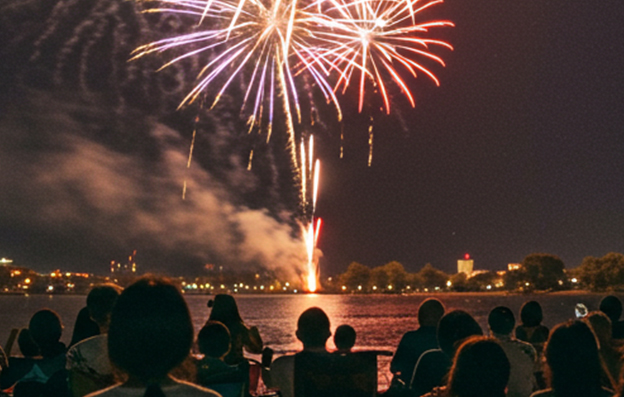
The annual Seoul World Fireworks Festival on Sept. 5 is set to draw more than 1 million people along the Han River, creating a major test for South Korea’s increasingly sophisticated approach to managing mass gatherings. For U.S. companies and investors, the event offers a window into a growing market for crowd-monitoring technology, emergency communications and urban safety infrastructure as Korean cities invest more heavily in public-event management.
Seoul and neighboring districts are expanding preparations beyond basic crowd control to cover traffic, medical services, sanitation and inspections of lodging businesses for excessive price increases. Authorities will begin managing crowds on Sept. 4, when a preview event is scheduled ahead of the main fireworks display.
The city’s Mapo and Yeongdeungpo districts are preparing separate safety plans for areas expected to see the heaviest concentrations of spectators. Police, firefighters, military units and utility companies will maintain emergency communication channels throughout the two-day period.
Mapo District plans to deploy about 50 safety personnel and district employees on Sept. 4 and more than 100 on Sept. 5. Officials have identified areas around Mapo Station, Hapjeong-dong and Mapo Saebit Culture Forest as priority crowd-control zones.
Bamseom Park and Mapo Children’s Park, along the Han River, will be monitored as secondary areas of concern. Officials will use CCTV cameras at key locations to track crowd movements in real time from the district’s disaster-management control room.
Mapo District has coordinated with local police and fire departments, military units and Korea Electric Power Corp. on emergency response procedures. Officials recently held a joint meeting to review crowd-control measures and contingency plans.
Yeongdeungpo District is planning a larger deployment, with 452 staff members expected to work over the two-day period, excluding police personnel. The district plans to assign 124 staff members on Sept. 4 and 328 on Sept. 5.
The personnel will cover crowd safety, traffic, environmental services, medical support and administrative operations. Of the total, 101 will be assigned specifically to safety management.
Officials will use CCTV cameras, the Ministry of the Interior and Safety’s crowd-management system and a dedicated disaster-safety communications network to monitor crowd density. Emergency text alerts will be issued if authorities detect conditions that could lead to dangerous crowding.
The expanded preparations underscore a broader shift in South Korea toward technology-driven crowd management at large public events. Real-time surveillance, emergency communications and coordinated response systems are becoming increasingly central to how local governments manage the risks associated with mass gatherings.