The race to commercialize autonomous vehicles is shifting from a contest over electric-car hardware to one increasingly driven by artificial intelligence, computing power and access to real-world driving data. For U.S.
technology and automotive investors, Hyundai Motor Group’s latest roadmap offers another potential demand channel for Nvidia’s automotive computing platforms while underscoring how far traditional automakers still have to go to catch Tesla and leading Chinese rivals.
Hyundai plans to begin mass-producing vehicles capable of navigating complex urban roads in the second half of 2028, expanding autonomous-driving capabilities beyond highways. The South Korean auto group will initially rely on Nvidia technology to accelerate commercialization before deploying its own Atria AI system in the second half of 2029.
Hyundai unveiled the plan at an autonomous-driving media event at the headquarters of its autonomous-driving affiliate 42dot in Seongnam, South Korea, on September 11.
The company plans to introduce Level 2+ vehicles in the first half of 2028 that can change lanes, pass other vehicles and enter and exit highways while requiring drivers to remain attentive. In the second half of the year, Hyundai plans to bring Level 2++ technology to mass-produced vehicles, enabling them to handle more difficult urban situations such as unprotected left turns and avoiding pedestrians in congested areas.
The initial vehicle models have yet to be determined.
Hyundai’s decision to use Nvidia as its first mass-production partner reflects the economics of autonomous driving, where high-performance computing and data are becoming as important as the vehicle itself.
The company plans to use Nvidia’s automotive hardware platform and is considering buying and using simulation and road-driving datasets accumulated through Nvidia’s global partnerships. The approach could allow Hyundai to move into commercial deployment sooner while it continues developing its own autonomous-driving technology.
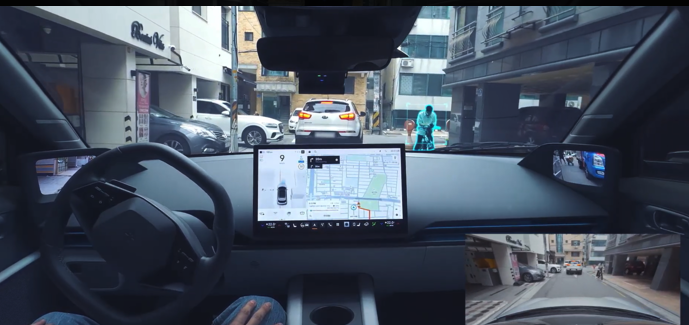
Hyundai also released about 20 minutes of footage showing an Ioniq 6 equipped with its Atria AI system driving on real roads. The vehicle, carrying Hyundai executive Park Min-woo and other passengers, navigated busy roads in Seoul’s Gangnam district and Jamsil, as well as rainy conditions in Pangyo.
The system avoided illegally parked vehicles and adjusted its speed in response to vehicles merging into its lane. But the demonstration also exposed limitations in handling unusual road situations.
On a section of the Olympic Expressway leading toward Dongjak Bridge, the vehicle appeared to misinterpret a road boundary and attempted to move toward a shoulder parking area. It also detected an aggressively merging vehicle late and responded with sudden braking.
Those incidents highlight the technological gap Hyundai is trying to close.
Tesla began distributing its FSD beta to some customers in October 2020, allowing vehicles to navigate public roads and handle functions including intersections and left and right turns. The company moved into broader commercialization in 2022. Chinese electric-vehicle maker XPeng officially launched its City NGP urban-driving system in September 2022.
Based on those timelines, Hyundai is roughly eight years behind Tesla and six years behind XPeng in bringing comparable urban-driving technology to market. Its own timetable for deploying proprietary AI has also slipped from an original target of late 2027 to the second half of 2029.
The more difficult gap to close may be data.
Tesla’s global autonomous-driving fleet had generated more than 10 billion miles of driving data by May, while Baidu’s Apollo Go robotaxi program had accumulated more than 217 million miles of real-world driving, according to figures cited by Hyundai.
Hyundai currently operates about 40 autonomous-driving test vehicles, logging roughly 80 vehicle-hours a week. The company plans to begin collecting data at much larger scale next year through a 200-vehicle autonomous-driving pilot project in the Jeonnam-Gwangju Integrated Special City.
Hyundai hopes to accelerate that process through a “data flywheel.” Vehicles will collect driving data, cloud-based AI will use it to improve autonomous-driving models, and updated versions will then be delivered back to vehicles through over-the-air software updates.
Park said Hyundai could potentially bring its proprietary AI to market sooner with a more aggressive development schedule. But he said the company does not want to sacrifice safety and reliability to close the gap faster.
“We decided that we cannot afford to rush and release a Level 2++ system with an incomplete level of performance,” Mr. Park said. “We will focus on commercialization that prioritizes safety and technical maturity.”
For Hyundai, the strategy amounts to a race on two fronts: using Nvidia’s technology to reach the market sooner while building the data and software capabilities needed to eventually rely more heavily on its own AI. For investors, the outcome could help determine whether established automakers can turn autonomous driving into a durable software business—or remain dependent on technology suppliers as the industry advances.