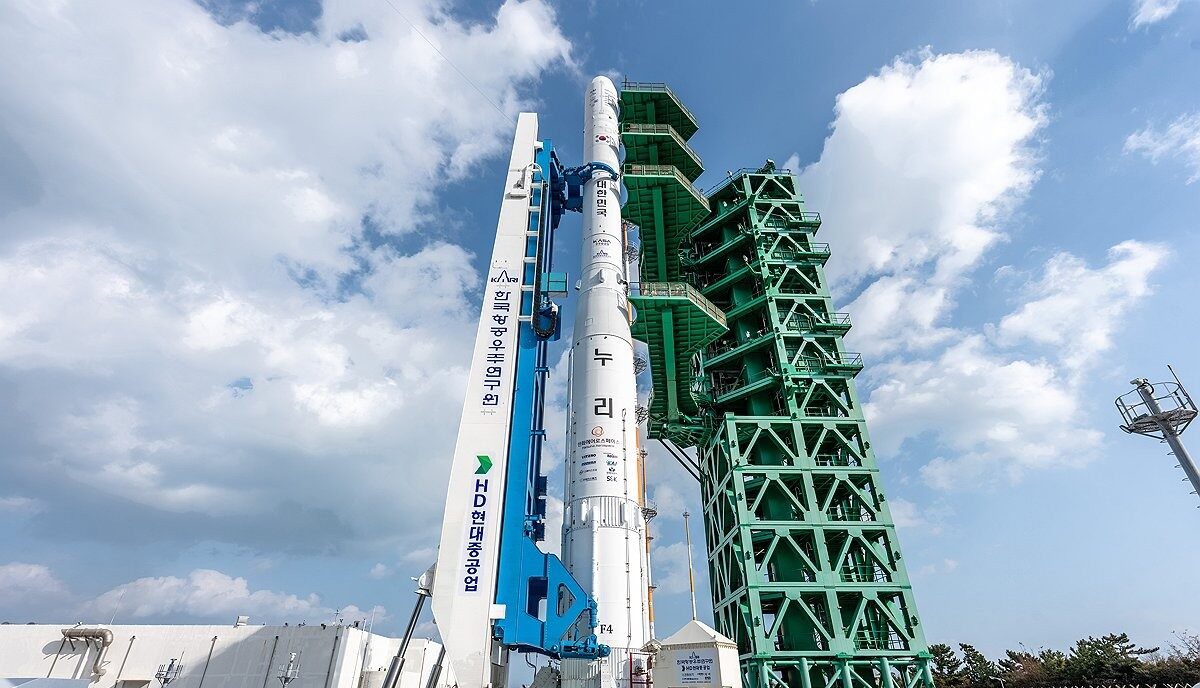
South Korea’s next Nuri rocket launch is set to test more than satellite-deployment technology: It will offer investors a closer look at the country’s transition toward a commercially driven space industry, with private companies taking a larger role in launch operations and satellite infrastructure. The mission is scheduled for October 7, and 15 satellites have now arrived at the Naro Space Center for final preparations.
The fifth launch of Nuri, South Korea’s homegrown space launch vehicle, will deploy five primary satellites and 10 CubeSats. The mission is the first in the Nuri program to carry multiple primary payloads, requiring more precise orbital insertion and separation capabilities.
For U.S. aerospace companies and investors watching the Asian space market, the launch is another sign that South Korea is moving beyond government-led technology demonstrations toward a broader commercial ecosystem spanning launch services, satellites and space-based data.
The five primary satellites, a cluster known as Nos. 2 through 6, arrived at the launch center on August 24 and completed two weeks of inspections without reported problems. The 10 secondary satellites arrived on August 31 and September 3 and were assembled into launch dispensers on September 3.
The Korea Aerospace Research Institute, or KARI, plans to begin integrating the primary payloads with Nuri this week. The protective fairing is expected to be installed around mid-September, followed by full assembly of the rocket’s three stages by the end of September.
The mission’s biggest technical test will be the deployment of the five primary satellites into their designated orbits.
The satellites are designed to operate as a constellation, flying along the same orbital path at intervals so they can repeatedly observe the same locations. That makes precise separation and attitude control essential to ensure the satellites reach their intended trajectories without colliding.
Nuri’s third stage will use a more advanced attitude-control and separation system for the mission, according to Jong-chan Park, head of KARI’s Nuri development program.
The launch is also expected to accelerate the handoff of operational responsibilities from the government to private industry.
Hanwha Aerospace, which has been selected as Nuri’s system-integration company and is expected to assume increasing responsibility for future launches, will operate about 75% of the equipment at the launch-control center during the fifth mission. Its personnel will work under the supervision of KARI researchers.
That share is expected to increase during the sixth and seventh launches, as South Korea seeks to build private-sector capabilities needed for a sustainable commercial launch market.
For investors, the shift could be as important as the rocket’s technical performance. A growing commercial launch ecosystem could expand opportunities for South Korean and international companies in launch services, satellite production, ground systems and space-based data. It also creates potential partnerships for foreign aerospace businesses as South Korea seeks to strengthen its position in the global space industry.
The fifth mission is therefore a test of both technology and industrial policy. Successful deployment of multiple satellites would demonstrate greater launch flexibility, while the expanded role of private operators would provide an early measure of whether South Korea can turn its state-backed space program into a repeatable commercial business.
The teams involved in the launch are expected to continue testing and verification through the final weeks before liftoff. Researchers will take a break during the Chuseok holiday but are expected to work through other October holidays ahead of the launch.
“We will carefully and thoroughly carry out the procedures and verification that have been prepared,” Park said.