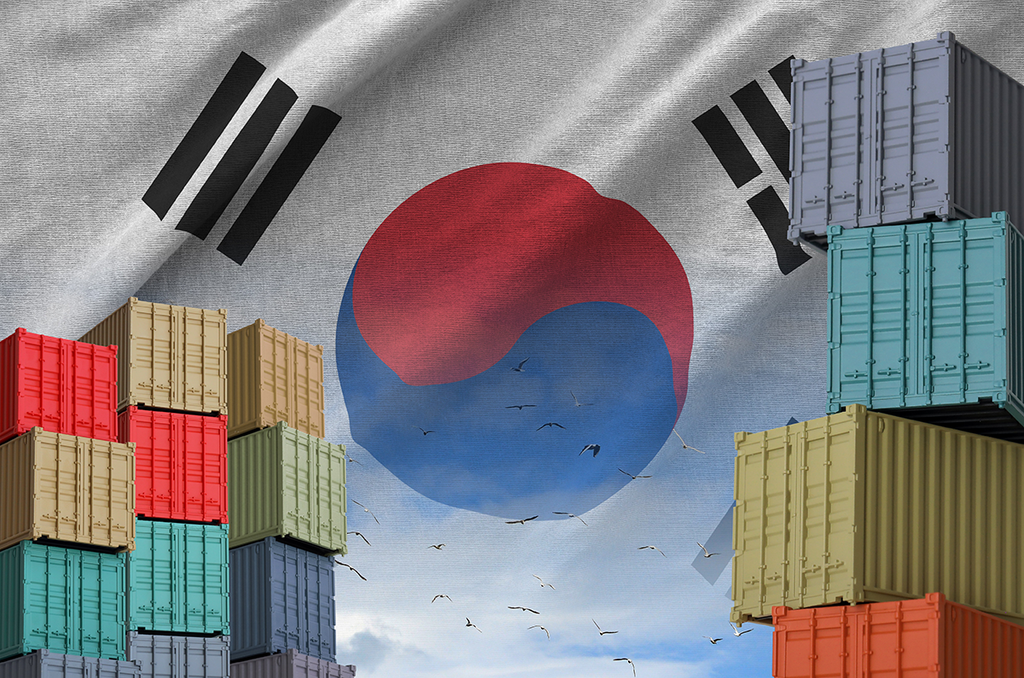
South Korea built much of its economic rise by selling manufactured goods to the rest of the world. Semiconductors, cars, ships, electronics and petroleum products have long made exports a critical engine of the country’s growth. Now the global AI investment boom is pushing that model to a scale South Korea has never seen before.
The country is on course to record $1 trillion in annual exports for the first time after shipping $710 billion of goods in just the first 248 days of 2026. That already exceeds the $709 billion exported during all of last year. The extraordinary acceleration has come largely from semiconductors, as the construction of AI computing infrastructure creates huge demand for the memory chips that South Korea specializes in producing.
That link makes the numbers important far beyond the Korean economy. Technology companies are spending heavily on data centers and AI computing equipment, particularly in the United States, and those systems require far more than processors alone. They also consume enormous quantities of memory. South Korea happens to be home to Samsung Electronics and SK Hynix, two of the world’s largest memory semiconductor manufacturers, putting the country directly in the supply chain feeding the AI buildout.
The result has been a dramatic change in South Korea’s export trajectory.
Semiconductor exports reached $281 billion from January through August, up 169.6% from the same period last year. Chips alone represented 40.6% of the country’s exports during that period.
The increase reflects both the quantity of chips being sold and stronger prices as demand has tightened the global market. South Korean exports have now expanded for 15 consecutive months, while global demand for chips used in AI systems has remained the central driver of that growth.
South Korea crossed another milestone in June, when monthly exports surpassed $100 billion for the first time. Despite the prolonged U.S. Iran war, higher energy costs and growing protectionism in major economies, the country continued to ship increasingly large volumes of technology products overseas.
The Korea Customs Service now expects annual exports to reach $1 trillion around early December if the current pace continues. President Lee Jae Myung publicized the projection from Customs Commissioner Lee Jong Wook. Only the United States, China and Germany have previously recorded annual exports of at least $1 trillion.
The speed of the increase becomes clearer when semiconductors are compared with South Korea’s other major industries.
Computer peripheral exports rose 262.2% from January through August, another category benefiting from strong demand for computing infrastructure. Petroleum product exports increased 40.7%, wireless communications equipment rose 28.1% and ship exports climbed 12.4%.
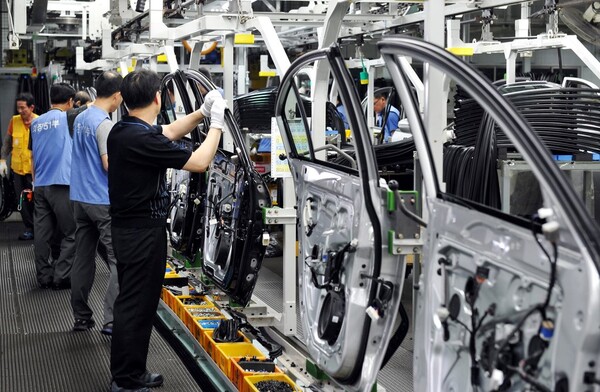
Cars, one of the industries that helped establish South Korea as a major manufacturing exporter, are moving in the opposite direction. Passenger vehicle exports declined 4.4%, while auto parts shipments fell 7.3%.
That divergence is important. South Korea is not nearing $1 trillion because all of its traditional export industries suddenly began expanding together. The country already had a large and diversified manufacturing export base. What changed in 2026 was the scale of the semiconductor boom layered on top of that base.
Samsung Electronics, South Korea’s largest technology company, produces memory chips as well as smartphones, consumer electronics and advanced semiconductors. SK Hynix is another major Korean memory producer and has become particularly important in high bandwidth memory, the type of memory designed to rapidly feed data to processors used for artificial intelligence.
As AI computing expands, those chips have become increasingly important to the economics of data centers. The effect can be seen on both sides of the Pacific. U.S. imports of capital goods including computers and semiconductors have risen sharply alongside AI investment, while South Korea has recorded extraordinary growth in exports of the same technology supply chain.
The chip boom is now large enough to change more than South Korea’s trade totals. It is also transforming the country’s external financial position.
According to the Korea Center for International Finance, eight major global investment banks expect South Korea’s current account surplus to average 16.0% of nominal GDP this year.
Goldman Sachs raised its estimate to 18.7% from 13.9%. Citigroup increased its projection to 18.2% from 16.5%, while Nomura raised its forecast to 19.7% from 15.7%. Excluding UBS, which has kept a 4.0% projection unchanged for an extended period, the average among the other seven institutions reaches 17.7%.
The surge is also rapidly narrowing South Korea’s gap with Taiwan, providing another indication of how the AI boom is reshaping Asia’s semiconductor economies.
The two countries occupy different positions in the chip supply chain. Taiwan is home to TSMC, the dominant manufacturer of many of the advanced logic processors used in modern computing. South Korea has particular strength in memory through Samsung Electronics and SK Hynix. AI systems need both processing power and increasingly large amounts of memory, allowing demand to spread across both economies.
Comparable projections from six investment banks put South Korea’s current account surplus at 18.1% of GDP and Taiwan’s at 21.5%, narrowing the difference to 3.4 percentage points.
Only a year earlier, the gap stood at 10.5 percentage points. Taiwan recorded a surplus equal to 17.5% of GDP, compared with 7.0% for South Korea.
That rapid change helps explain what is really behind South Korea’s approach toward $1 trillion in exports.
The country did not suddenly become an export economy in 2026. It already possessed one of the world’s largest manufacturing bases across semiconductors, automobiles, ships and electronics. What the AI boom supplied was an unusually powerful new source of demand for the industry in which South Korea holds some of its strongest global positions.
The same spending cycle filling U.S. data centers with AI hardware is therefore showing up thousands of miles away in Korean factories, trade surpluses and national economic statistics. If South Korea crosses $1 trillion this year, the milestone will be one of the clearest demonstrations yet of how far the AI infrastructure boom has spread through the global economy.