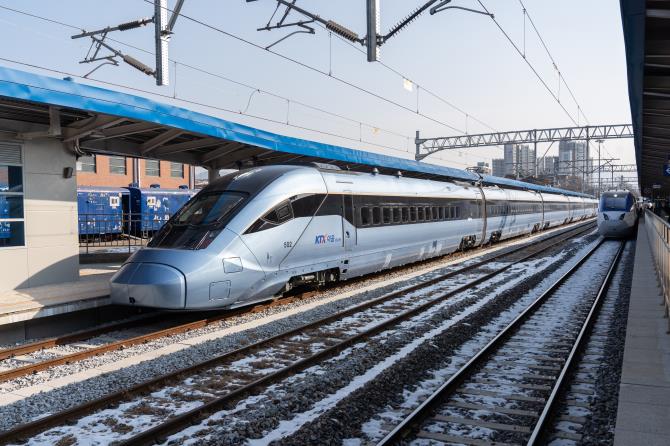
South Korea’s high-speed rail market is shifting toward lower fares and higher capacity, a change that could reshape passenger demand and the economics of the country’s rail industry. For U.S. investors and transportation companies, the bigger question is whether a government-led push for cheaper rail travel can generate enough additional traffic and operating efficiencies to offset lower revenue per ticket.
The new pricing structure took effect on September 1, when state-run Korea Railroad Corp., known as Korail, and SR began integrated high-speed rail operations. Fares across the unified network are now about 10% lower on average than the previous KTX prices, based on SR’s fare formula.
The change gives South Korean passengers an immediate benefit while creating a new financial challenge for the country’s largest rail operator. Weekend seat capacity is also expected to increase by more than 17,000 seats, giving the industry an opportunity to make up for lower fares by carrying more passengers.
The government plans to maintain the reduced fares for three years, unless there is a significant change in policy. The fare reduction was developed as part of the broader integration plan negotiated by the Korea Fair Trade Commission and the Ministry of Land, Infrastructure and Transport.
The timing puts Korail’s finances under particular scrutiny.
Korail’s debt is projected to rise to about $19.4 billion in 2028, from roughly $16.9 billion in 2026, according to the government’s medium-term financial plan. Its debt ratio is expected to climb from 323.4% in 2026 to 395.8% in 2028, close to four times equity.
That means the three-year period during which fares are expected to remain lower will overlap with the peak of Korail’s projected financial burden.
Lower fares would normally put pressure on revenue. The government, however, argues that the impact can be offset by three factors: more seats, expanded rail capacity and savings from eliminating overlapping operations following the integration of Korail and SR.
The strategy is essentially a bet on volume and efficiency.
By adding seats and services, the government expects the unified network to generate additional passenger revenue even at lower prices. At the same time, integrating the two operators is expected to reduce duplicated costs and improve the efficiency of train and infrastructure use.
If those gains materialize as planned, Korail’s finances could begin to improve after 2028. Government projections show debt falling to about $17.3 billion in 2029 and $13.3 billion in 2030. The debt ratio is expected to decline to 184.8% by 2030.
The financial trajectory is therefore critical to the case for keeping fares low. The government is effectively accepting lower revenue per passenger today in the expectation that a larger and more efficient rail network will generate stronger overall revenue and lower operating costs over time.
For investors, the key metric will be whether additional passenger revenue grows faster than the revenue lost through the fare reduction. If demand responds strongly to cheaper tickets, Korail could increase utilization while improving its financial position. If demand falls short, the fare policy could deepen the company’s losses during a period of rising debt and interest expenses.
The policy also changes the competitive structure of South Korea’s high-speed rail market. SRT was introduced as a separate operator to increase competition with KTX. The integration effectively replaces that operator-level competition with a single network emphasizing lower fares, expanded capacity and operating efficiency.
That could benefit consumers but leaves less room for Korail to use pricing as a tool to strengthen its finances.
South Korean President Lee Jae Myung has raised concerns about the potential fiscal consequences, warning that persistent losses at a state-owned company could ultimately require taxpayer support. The government has said, however, that the fare reduction has been incorporated into Korail’s longer-term financial projections.
The Fair Trade Commission and the transport ministry plan to monitor the implementation of the integration plan, including changes in revenue, capacity and operating costs.
For U.S. investors, the outcome offers a broader lesson about investing in government-controlled infrastructure businesses: lower prices can stimulate demand, but they can also transfer financial risk from consumers to the operator and, ultimately, the public sector.
The success of South Korea’s rail integration will therefore depend less on whether cheaper tickets attract passengers than on whether the additional volume and efficiency are large enough to pay for the discount.
For Korail, the next three years will be a test of whether 10% lower fares can ultimately produce a stronger rail network without creating a larger bill for taxpayers.