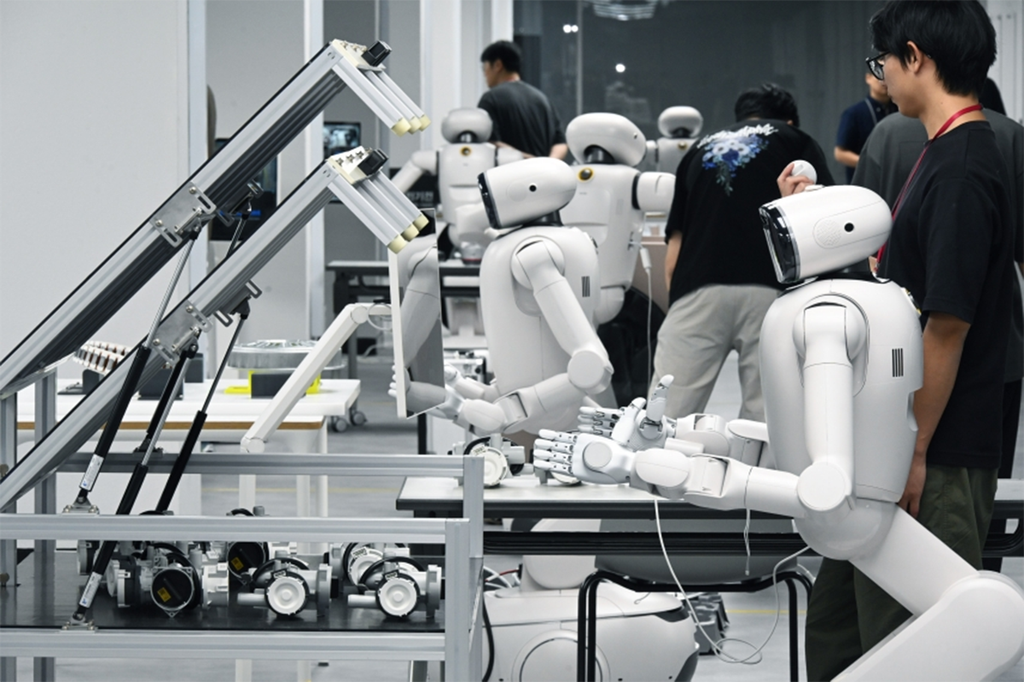
LG Electronics, the South Korean company best known in the U.S. for televisions and home appliances, is increasing hiring in robotics and smart factories as it moves more aggressively into physical AI with Nvidia.
The timing matters more than the hiring numbers themselves. LG and Nvidia have spent recent months expanding their partnership from discussions into actual development work involving humanoid robots, AI factories, mobility and next-generation data centers.
Nvidia Chief Executive Jensen Huang said in June that the companies were working together on humanoid robotics and future data-center systems, while LG said this month that the two sides were accelerating robotics collaboration and building a system that combines LG’s manufacturing data with Nvidia’s robotics platform.
Against that backdrop, LG’s decision to concentrate new hiring in robotics, mobility and smart factories looks less like a routine recruitment cycle and more like an effort to put additional engineers behind businesses that are becoming central to its AI strategy. The company has not said the hiring was specifically ordered to support Nvidia projects, so a direct causal link cannot be established. But the overlap between the areas where LG is hiring and the areas where its Nvidia partnership is expanding is difficult to ignore.
LG Electronics is recruiting across 12 job categories for the second half of the year, including research and development, production technology, electrical and mechanical engineering, sales and marketing, supply-chain management, procurement, manufacturing, quality, finance, human resources and strategic planning. Applications are open through Sept. 13.
The company expects to add personnel particularly in robotics, mobility, smart factories and heating, ventilation and air conditioning, or HVAC, all businesses LG has identified as future growth areas.
Robotics has taken on greater importance inside LG this year. The company established a dedicated Robotics Business Center and has said it plans to expand from industrial and commercial robots into home robots. LG and Nvidia are also developing physical AI systems that connect AI model development, robot simulation and training, edge deployment and digital twins used to reproduce factories virtually.
That gives the hiring push significance beyond South Korea. Nvidia is trying to extend artificial intelligence from servers and software into machines capable of operating in factories, warehouses and other physical environments. That effort depends on manufacturing partners that can combine AI computing with motors, mechanical systems, production equipment and large volumes of real-world industrial data.
LG fits that role because its operations extend well beyond consumer electronics. The company manufactures appliances, automotive components and industrial systems and operates production networks that generate the type of manufacturing data needed to train and improve physical AI systems. Nvidia has described its partnership with LG as combining its AI platform with LG’s capabilities in consumer electronics, robotics, mobility components and data-center technologies.
LG is also looking outside South Korea for the engineers needed to support that expansion. Beginning Sept. 9, the company plans to hold recruiting sessions for master’s and doctoral-level R&D talent at six North American universities, including the Massachusetts Institute of Technology, Carnegie Mellon University, the University of Michigan, Purdue University, the University of Illinois Urbana-Champaign and the University of Wisconsin-Madison.
At home, LG will begin visiting 12 South Korean universities on Aug. 31, starting with the Korea Advanced Institute of Science and Technology, or KAIST. The company will also visit Seoul National University, Yonsei University, Pohang University of Science and Technology and other major engineering schools.
HVAC is another part of the hiring campaign that connects directly to LG’s broader AI ambitions. Nvidia and LG have said they are working on next-generation data centers, including cooling systems, power delivery and overall facility design. That places LG’s heating and cooling business alongside robotics as another area that could benefit from the rapid construction of AI infrastructure.
LG shifted away from large annual hiring rounds in 2020 in favor of rolling recruitment, but it still conducts broader campaigns when demand for new graduates and experienced workers rises.
This time, where LG is hiring is more revealing than the fact that it is hiring at all. The company is adding engineers in many of the same businesses now at the center of its Nvidia partnership, suggesting that LG is preparing to commit more people and manufacturing capacity to a physical AI market that is moving from experimental projects toward commercial deployment.