Boston Dynamics, the Massachusetts robotics company controlled by South Korea’s Hyundai Motor Group, is expanding the commercial role of its four legged Spot robot by putting it to work on routine industrial inspections rather than simply demonstrating what advanced robots can do.
Kirin Brewery, one of Japan’s largest beer makers, has deployed Spot at its Chitose plant in Hokkaido, where the robot now patrols five routes and checks about 100 equipment points. Kirin expects the system to reduce the time employees spend on routine inspections by roughly 650 hours a year.
That figure is what makes the project significant beyond a Japanese brewery. Boston Dynamics has spent years developing robots capable of navigating environments built for people. The commercial challenge is proving that those machines can perform enough useful work to justify their place in factories and other industrial facilities. Kirin is effectively testing that proposition with a task that is repetitive, measurable and still heavily dependent on human labor.
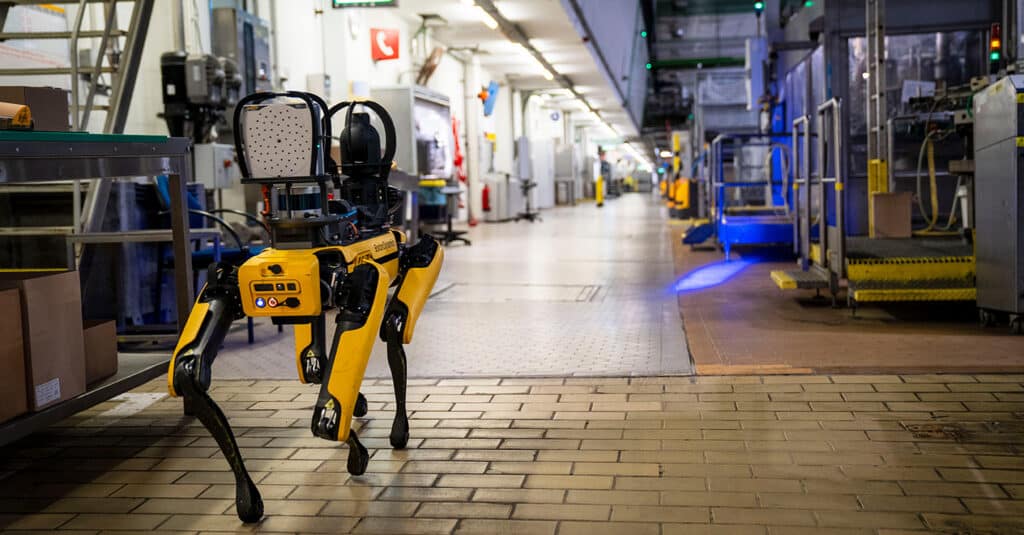
Spot moves through the plant carrying sensors that allow it to inspect equipment without requiring an employee to walk the same route. In addition to visual monitoring, the robot is equipped with acoustic sensors that can detect unusual sounds from machinery, giving maintenance teams another way to identify possible equipment problems.
Kirin is using the deployment not only to reduce inspection work but also to learn how robots can be incorporated into everyday factory operations. The brewer said it wants employees to gain experience working alongside robotic systems as it prepares for wider use of automation.
That makes the Chitose plant a useful proving ground for Boston Dynamics. Spot was designed to move across stairs, uneven surfaces and other areas where fixed automation or conventional wheeled machines can be difficult to use. Those capabilities allow the robot to perform inspection work inside facilities that were designed around human movement.
The deployment was carried out through Tohoku Enterprise, Boston Dynamics’ official distribution partner in Japan. The Japanese industrial equipment company has been working to expand Spot’s use across different types of industrial facilities.
Tohoku Enterprise previously worked with IBM Japan on a demonstration at Chubu Centrair International Airport near Nagoya in 2024. It also conducted a proof of concept with Cosmo Oil this year to test autonomous facility inspections at an oil refinery.
Those projects point to a broader commercial strategy for Spot. Boston Dynamics is not trying to turn the robot into a replacement for every factory worker. It is targeting specific jobs that require employees to repeatedly walk through large or difficult industrial sites, gather information and look for signs of equipment trouble.
Hyundai Motor Group acquired control of Boston Dynamics in 2021 as part of its expansion beyond automobiles and into robotics and other mobility technologies. For the Korean automotive group, the value of Boston Dynamics ultimately depends less on how impressive its robots look and more on whether companies are willing to use them as everyday industrial equipment.
Kirin’s deployment provides a relativ\ely simple measure of that progress. Spot is covering five routes, checking about 100 locations and potentially removing hundreds of hours of repetitive inspection work from employees each year.
For Boston Dynamics, that is the transition that matters. Spot is moving from a robot known for what it can demonstrate to a machine that industrial customers are beginning to judge by the work it can actually save.