
The global shift toward electric commercial vehicles is opening a new battleground for automakers, with fleet operators demanding vehicles tailored to specific businesses rather than one-size-fits-all vans. Kia is betting its purpose-built electric-vehicle strategy can capture that shift, offering U.S. and global investors exposure to a potentially higher-margin market built around fleet software, vehicle conversions and recurring commercial demand.
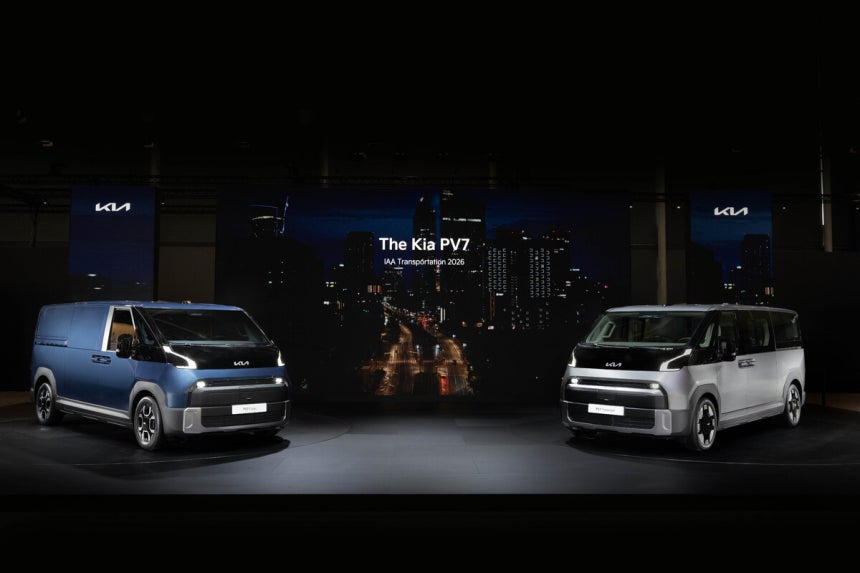
Kia unveiled its new PV7 electric van September 14 at IAA Transportation 2026 in Hannover, Germany, expanding its purpose-built vehicle, or PBV, lineup as it seeks a larger share of the global light-commercial-vehicle market.
The PV7 will initially be sold in South Korea and Europe in long-wheelbase cargo and passenger versions during the second half of 2027. Kia plans to develop 23 derivatives and conversion models by varying the vehicle’s wheelbase, length and height through its flexible body system.
The company also plans to introduce a larger PV9 in 2029, extending its PBV strategy into additional commercial-vehicle segments.
The push follows the early success of Kia’s PV5, which was launched last year and won the 2026 International Van of the Year award. Kia says the PV5 has also become the leading model in Europe’s C-segment electric-van market.
The PV7 is based on Hyundai Motor Group’s dedicated PBV electric platform, E-GMP.S. Its long-range version uses a 96.2-kilowatt-hour nickel-cobalt-manganese battery and is rated for more than 286 miles of range under Europe’s WLTP testing standard.
A 200-kilowatt front motor powers the van, while its 350-kilowatt fast-charging capability can take the battery from 10% to 80% in about 25 minutes. Kia plans to add an all-wheel-drive version later.
The vehicle also supports vehicle-to-load technology, allowing operators to use the battery to supply electricity to external equipment. Front and rear-side charging ports are designed to make charging easier in different parking configurations.
At about 17.6 feet long with an 11.5-foot wheelbase, the PV7 is designed around commercial payloads and flexible interior configurations.
The cargo model has a loading height of about 21.7 inches and can carry as many as three Euro pallets. A load-through partition allows longer cargo to extend into the cabin, while a heavy-load driving mode adjusts vehicle performance based on the weight being carried.
The passenger version will be offered with seven-, nine- and 11-seat configurations.
Software is another pillar of Kia’s strategy. The PV7 will use Pleos Connect, a next-generation infotainment platform based on Android Automotive, along with Gleo AI, a generative-AI assistant. Fleet operators will have access to Pleos Fleet, a system designed to manage and monitor commercial vehicles.
Kia is also adding a seven-airbag system and advanced driver-assistance technology, including a system designed to prevent unintended acceleration caused by pedal misapplication.
The strategy reflects a broader transformation in the commercial-vehicle industry. Automakers are increasingly competing on total fleet economics—including energy costs, uptime, software and customization—as businesses electrify delivery, transportation and service fleets.
That creates a potentially attractive market for manufacturers capable of selling more than the vehicle itself. Specialized body configurations and fleet-management software can deepen relationships with commercial customers and potentially generate additional revenue over the life of a fleet.
Kia is displaying 10 PBVs at IAA Transportation, which runs from September 15 through September 20. Its display includes one long-wheelbase PV7 passenger model, two PV7 cargo models and seven PV5 variants, including cargo, passenger, wheelchair-accessible and food-truck configurations.
The trade show is drawing about 2,000 automakers, suppliers and logistics companies from 41 countries. Kia has set up a roughly 16,480-square-foot exhibition area to showcase its expanding commercial-EV portfolio.
For investors, the key test will be whether Kia can turn its PBV platform into a scalable fleet business rather than simply another line of electric vehicles. The combination of modular vehicle designs, specialized conversions and fleet software could give Kia a way to capture more value from the commercial-EV transition as fleet operators look for increasingly customized electric transportation.