India’s fast-growing auto market is becoming an increasingly important battleground for global carmakers seeking new sources of growth beyond mature markets. Hyundai Motor is nearing 10 million cumulative vehicle sales in the country, a milestone that underscores how locally tailored SUVs, expanding manufacturing capacity and export ambitions are reshaping the company’s strategy in one of the world’s most competitive automotive markets. For U.S. automakers and investors, Hyundai’s approach offers a window into the opportunities—and operational challenges—of building scale in India.
Hyundai had sold 9,884,960 vehicles in India through the third quarter, according to the Society of Indian Automobile Manufacturers. The company is on track to surpass 10 million cumulative sales by year-end, nearly three decades after beginning local production of the Santro hatchback at its Chennai plant in 1998.
The milestone reflects a steady expansion in Hyundai’s Indian business. The company surpassed 1 million cumulative sales in 2007 and 5 million in 2017, building market share through sustained investment and a lineup designed around local consumer preferences.
The shift toward SUVs has become a major driver of Hyundai’s growth, mirroring a broader transformation in the automotive industry as buyers increasingly favor higher-riding vehicles over traditional small cars.
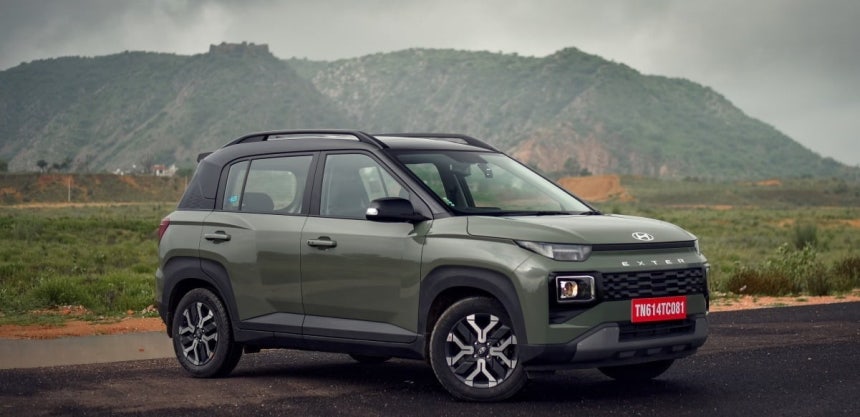
Hyundai’s Exter, a compact SUV introduced in 2023, sold more than 47,000 units in its first six months. Competitive pricing and features including six standard airbags and a sunroof helped the model gain traction among Indian buyers.
The Creta, launched in 2015, has also become a cornerstone of the company’s business. It ranked as India’s top-selling SUV for three consecutive months shortly after its debut, sold more than 40,000 units in its first year and won the 2016 Indian Car of the Year award.
Hyundai has expanded beyond its original Santro hatchback to offer the Creta, Venue compact SUV, three-row Alcazar and Exter. Last year, it added the Creta Electric, its first locally produced electric vehicle in India. The company also plans to introduce a redesigned Bayon compact SUV in the country this year.
The broader lineup helped Hyundai surpass 500,000 annual vehicle sales in India for the first time in 2016. In 2020, strong demand for the Venue and Creta pushed the company’s market share to a record 17.4%.
Hyundai sold 605,433 vehicles in India in 2024, its highest annual total since entering the market. SUVs accounted for 398,937 units, or nearly 66% of sales. The Exter, Creta and Alcazar together contributed 282,666 units, highlighting the importance of locally targeted SUVs to the company’s performance.
Through the first nine months of this year, Hyundai sold 471,724 vehicles in India, including 316,026 SUVs. The figures reinforce the segment’s role as the principal engine of demand for the automaker.
Hyundai’s next growth phase depends not only on domestic demand but also on its ability to use India as a competitive manufacturing base for overseas markets.
The company operates two plants in Chennai and one in Pune, with combined annual production capacity of about 1 million vehicles. The Chennai facilities can produce 824,000 vehicles a year, while the Pune plant has capacity for another 170,000.
Hyundai plans to expand annual capacity at Pune to 250,000 vehicles by 2028 and 320,000 by 2030. The investment would lift its total annual production capacity in India to more than 1.1 million vehicles.
The company also aims to source more than 90% of its components locally by 2030, helping lower costs and reduce exposure to imported parts. It plans to raise exports to as much as 30% of production, making India a larger manufacturing and distribution base for international markets.
For global automakers, including U.S. manufacturers evaluating where to invest in future production, India offers the prospect of a large domestic customer base alongside a potential platform for exports. But capturing that opportunity requires products suited to local budgets, a reliable supplier network and the scale to compete on cost.
Hyundai’s strategy reflects a wider industry shift: India is evolving from a market for entry-level vehicles into a major arena for SUV growth, electrification and export-oriented manufacturing. Crossing 10 million cumulative sales would mark a milestone in that transition. The more consequential test will be whether Hyundai can translate its established position into higher production efficiency, stronger exports and sustainable growth as competition intensifies.