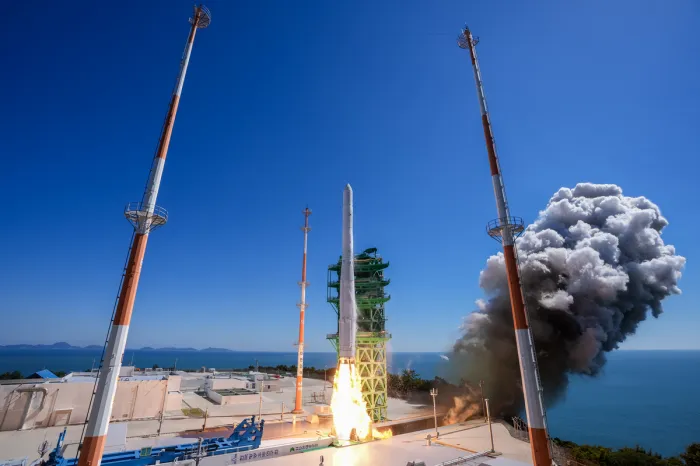
South Korea is moving to build a commercial launch industry around its homegrown Nuri rocket, a development that could create new opportunities for U.S. satellite operators, aerospace companies and investors as Seoul shifts from government-led development toward a private-sector space economy.
The fifth Nuri launch raised the rocket’s cumulative success rate to 80% and demonstrated the ability to place multiple satellites into precise orbits on a single mission, the Korea AeroSpace Administration said October 7. The mission marked the first time South Korea had deployed five primary satellites simultaneously.
For U.S. space companies, the significance extends beyond the launch itself. South Korea is seeking to establish a domestic alternative in the growing small-satellite launch market, where launch frequency, reliability and cost are increasingly important competitive factors.
The rocket successfully reached its target altitude and velocity and deployed all five primary satellites at their intended separation angles, key criteria used to determine the success of the mission.
One CubeSat operated by Quarterion was not deployed after its deployment tube cover failed to open. The launch authority said signals from Nuri were transmitted normally but that additional analysis was needed to determine why the deployment mechanism failed.
The successful deployment of the five-satellite cluster nevertheless demonstrated a capability aimed at commercial customers. Launching several small satellites on a single rocket can allow operators to target specific orbital positions and launch windows while spreading costs across multiple payloads.
South Korea plans to launch Nuri for a sixth time in the second half of 2027, with another five-satellite cluster expected to be the primary payload. The government aims to conduct at least one Nuri launch each year through 2032 as it works to improve reliability and establish a private-sector-led commercial launch-service market.
Hanwha Aerospace is taking a larger role in that transition. The company has led Nuri’s manufacturing and assembly since the fourth launch and expanded its responsibilities to launch preparation and operations for the fifth mission.
Hanwha personnel directly operated about 20 consoles at the launch control center during the latest mission. The company is expected to take responsibility for most console operations during the sixth launch. It did not operate consoles responsible for the onboard computer, propulsion supply and oxidizer systems during the fifth launch.
The company plans to accelerate the commercialization of technologies developed through the government-led Nuri program, with the aim of building a sustainable private space industry around the rocket.
Reliability remains the key challenge. Global commercial launch providers generally target success rates above 90%, according to Oh. South Korea remains a relative newcomer, with about 2,750 U.S. launches through August, more than 700 in China and more than 100 each in India and Japan, based on figures cited by the space agency.
South Korea plans to maintain government leadership through 2028 and transition to private-sector leadership beginning in 2029. Officials say cooperation between government and industry will remain necessary until the launch system achieves a more stable record.
The next-generation launch vehicle is expected to involve private companies alongside the government from the design and manufacturing stages. Greater industry participation in vehicle design could help improve cost efficiency and make the system more commercially competitive, Oh said.
The program also reflects a broader shift toward satellite constellations. Clusters of lower-cost satellites can provide more frequent and precise observations than a single large satellite, potentially improving responses to natural disasters and other emergencies.
For investors, Nuri’s next test will be less about proving that South Korea can reach orbit and more about whether it can do so repeatedly, affordably and for paying customers. If the government can improve reliability while transferring more responsibility to private industry, the Nuri program could become the foundation of a larger South Korean commercial space market.