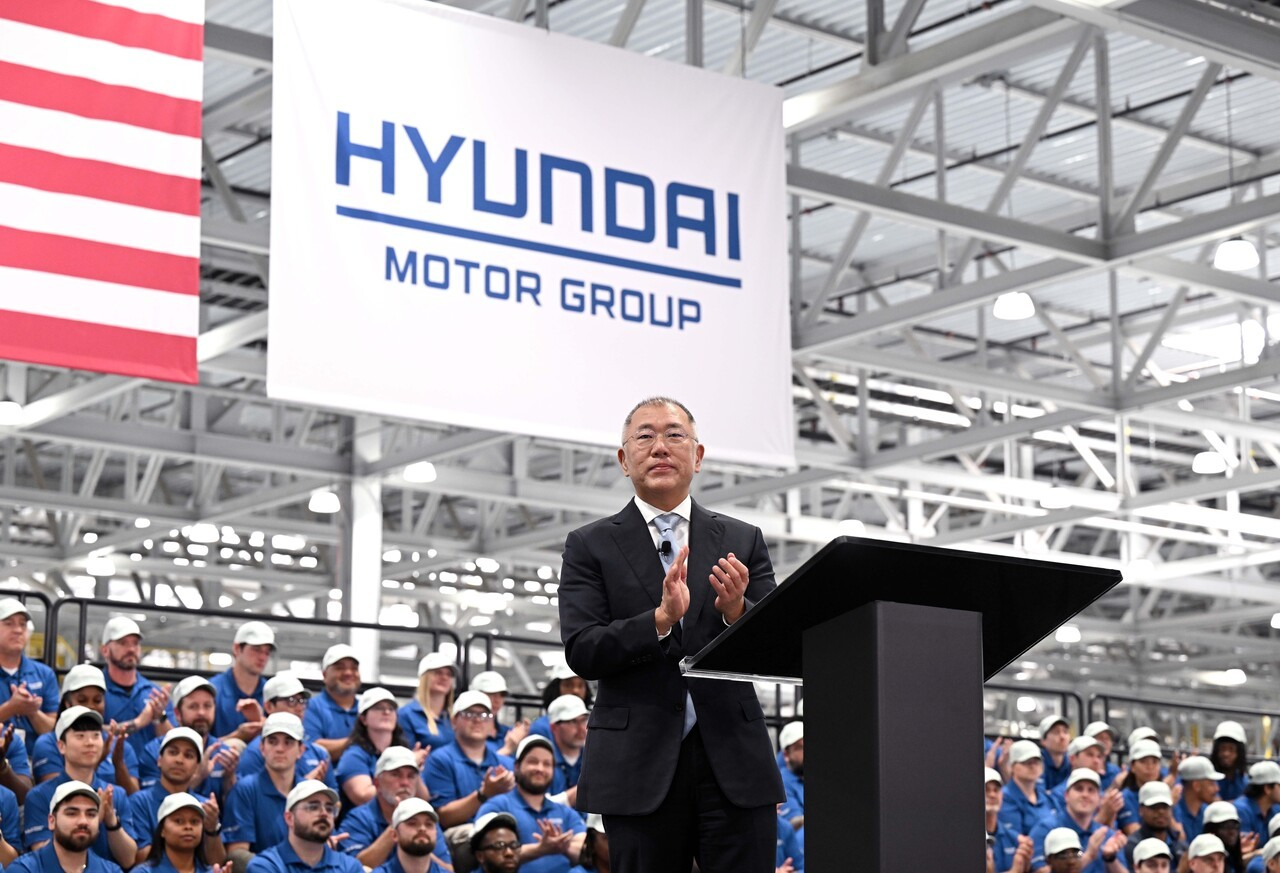
For U.S. automakers and investors, the rapid shift toward hybrid vehicles is reshaping the competitive landscape just as electric-vehicle demand loses momentum. Hyundai Motor and Kia are emerging as notable beneficiaries, overtaking Ford in U.S. monthly market share for a second consecutive month in August as their hybrid sales surged.
Hyundai and Kia sold 178,405 vehicles in the U.S. in August, down just 0.6% from a year earlier, while total U.S. vehicle sales declined 5.8%. Their combined market share climbed to 12.9%, the highest monthly level on record for the two automakers, according to industry data and market researcher Omdia cited September 30.
The August result followed a 12.1% share in July, when Hyundai and Kia sold 165,284 vehicles, up 5.0% from a year earlier. General Motors held the largest share at 16.7%, followed by Toyota at 15.9%, while Ford slipped to fourth at 12.0%.
Hyundai and Kia widened their lead over Ford to 1 percentage point, or 14,042 vehicles, in August, compared with a 0.1 percentage-point lead in July.
The gains are also narrowing Ford’s lead on a year-to-date basis. Through August, Hyundai and Kia had sold 1.26 million vehicles, giving them an 11.8% combined U.S. market share. Ford had sold 1.30 million vehicles for a 12.2% share, leaving a gap of 0.4 percentage point.
That gap has narrowed by 0.1 percentage point each month since June, putting Hyundai and Kia within striking distance of Ford on a quarterly and potentially annual basis.
The biggest driver is the U.S. hybrid market, which has continued to expand even as both gasoline-powered and battery-electric vehicle sales have weakened.
U.S. hybrid sales rose 20.7% to 1.66 million vehicles through August, making hybrids the only major powertrain category to post growth. Internal-combustion vehicle sales fell 2.9% to 8.24 million, while battery-electric vehicle sales plunged 26.8% to 648,350.
The shift comes as the U.S. EV market adjusts to the expiration of federal EV tax credits and changing fuel costs. For consumers hesitant to make the full switch to electric vehicles, hybrids are increasingly serving as a middle ground between traditional gasoline vehicles and battery-powered cars.
Hyundai and Kia have been positioned to capture that transition. They sold a combined 50,057 hybrid vehicles in August, their strongest monthly result. Hyundai sold 25,109 hybrids, up 33% from a year earlier, while Kia sold 24,948, up 65.7%.
The momentum has already put the Korean automakers ahead of Ford in sales for July and August combined. Hyundai and Kia sold 343,689 vehicles during the two months, about 15,800 more than Ford’s 327,896.
Analysts cited by CNBC and Bloomberg have estimated that Hyundai and Kia could sell about 511,421 vehicles in the third quarter, compared with 504,172 for Ford.
For U.S. automakers and investors, the shift highlights a key question for the industry: how long hybrids can sustain their growth as manufacturers balance EV investment with continued demand for gasoline-powered vehicles. Hyundai and Kia’s recent gains show that the transition to electrification in the U.S.
is not necessarily moving in a straight line from combustion engines to fully electric vehicles.