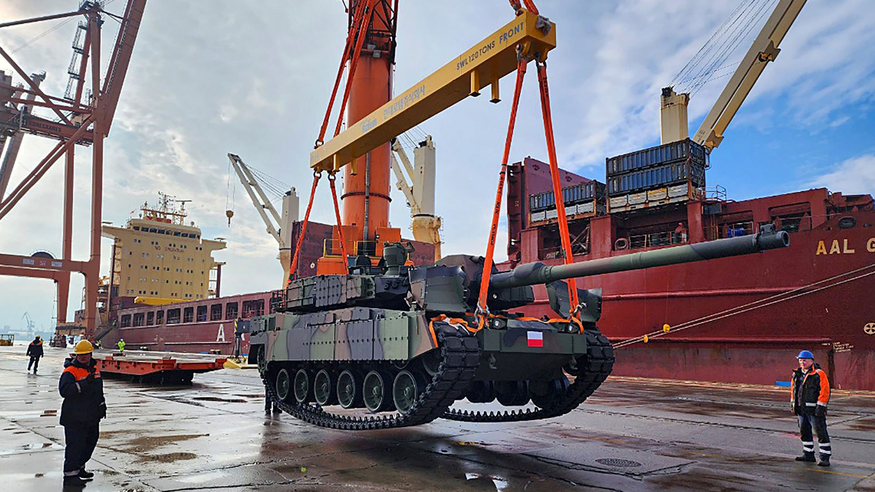
Poland has received 18 more South Korean K2 tanks as it races to rebuild and expand its armored forces on NATO’s eastern flank, where the country borders Belarus and Russia’s Kaliningrad region. The delivery is part of a military buildup that accelerated after Russia’s 2022 invasion of Ukraine and Poland’s transfer of older equipment to Kyiv.
That buildup has made Poland a major customer of both American and South Korean weapons. Warsaw has ordered hundreds of U.S. made Abrams tanks while simultaneously building a large K2 fleet, showing how one of Washington’s most important NATO allies is spreading major procurement across multiple suppliers rather than relying on a single source. The pattern matters to the U.S. defense industry because European governments are placing greater weight on how quickly weapons can be delivered and how much production can be moved closer to home.
South Korea is increasingly competing on both fronts. The latest K2 shipment is arriving as Poland prepares to move part of the program into domestic production, turning what began as an urgent purchase of foreign tanks into a longer term industrial partnership. That gives South Korean manufacturers a foothold inside Europe’s expanding defense production base rather than limiting their role to exporting equipment from Asia.
Polish Deputy Prime Minister and Defense Minister Władysław Kosiniak Kamysz said the 18 tanks would strengthen the combat capabilities of the 16th Mechanized Division. The division is responsible for northeastern Poland and has been replacing older armored vehicles with South Korean K2s.
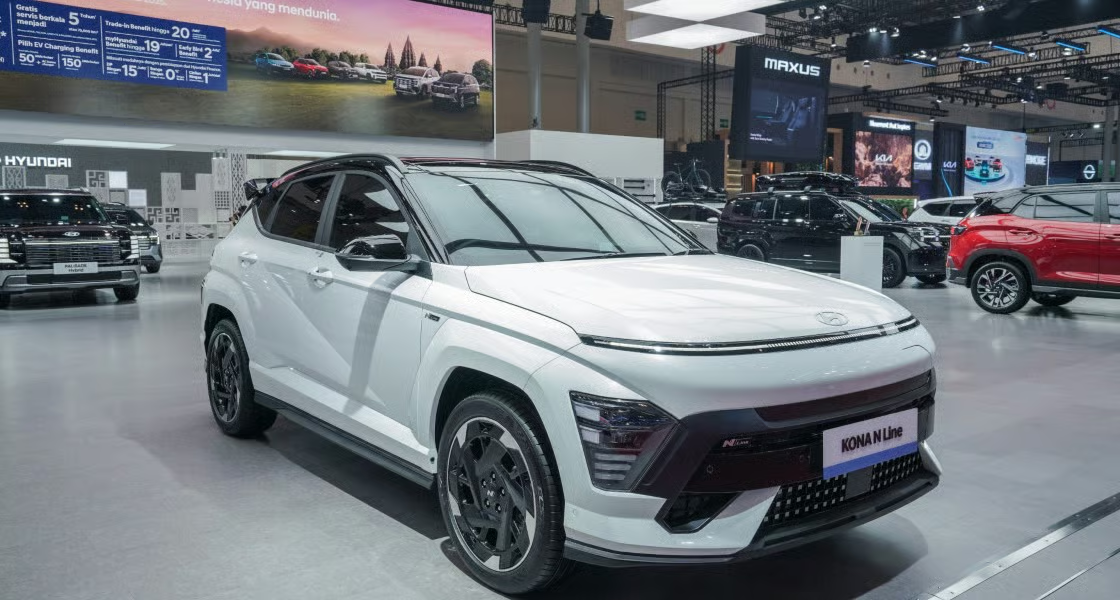
The tanks are made by Hyundai Rotem, a South Korean manufacturer of military vehicles and railway equipment. Poland turned to the company as it sought modern tanks that could be delivered quickly while it was simultaneously buying Abrams tanks from the U.S. Poland received its first K2s only months after signing its initial agreement in 2022, an unusually rapid timetable for a major armored vehicle program.
The latest 18 tanks follow an earlier batch of 28 delivered under Poland’s second K2 implementation contract. Hyundai Rotem has accelerated production at its Changwon manufacturing complex in South Korea as Warsaw pushes to field new armor without waiting for the longer timelines often associated with large defense procurement programs.
The second contract, signed in August 2025, covers another 180 K2 tanks. Of those, 116 K2GF models are scheduled for delivery from South Korea in 2026 and 2027. Another 64 tanks in the K2PL configuration, a version tailored to Polish requirements, are scheduled to follow between 2028 and 2030.
The larger shift begins with those K2PL tanks. Only the first three are scheduled to be built in South Korea. The remaining 61 are to be produced at Bumar Łabędy, a Polish armored vehicle manufacturer in Gliwice. The agreement includes technology transfers, production equipment and capabilities for servicing and maintaining the tanks inside Poland.
That local production component fits a broader change in Polish defense policy. Warsaw has been increasing purchases from domestic and Central European suppliers while seeking technology transfers and joint production from foreign contractors. Poland is trying to build more resilient defense supply chains closer to home as military spending rises across Europe.
The strategy creates a different competitive environment for U.S. and other Western defense contractors seeking business from Europe’s military expansion. Poland is not replacing American weapons with Korean equipment. Its forces are operating both Abrams and K2 tanks. But the K2 program shows that access to Europe’s growing defense budgets increasingly depends on more than the weapon itself, with production speed, technology transfer and local manufacturing becoming important parts of major contracts.
Poland’s broader framework agreement has envisioned the acquisition of as many as 1,000 K2 tanks. The 2025 contract brings the program further toward that goal while establishing the infrastructure needed to build and support future tanks in Poland.
The arrival of another 18 tanks is therefore a relatively small piece of a much larger shift. Poland is rebuilding one of NATO’s largest armored forces while South Korea is using fast deliveries and local production to secure a lasting position in a European defense market long dominated by American and Western European suppliers.