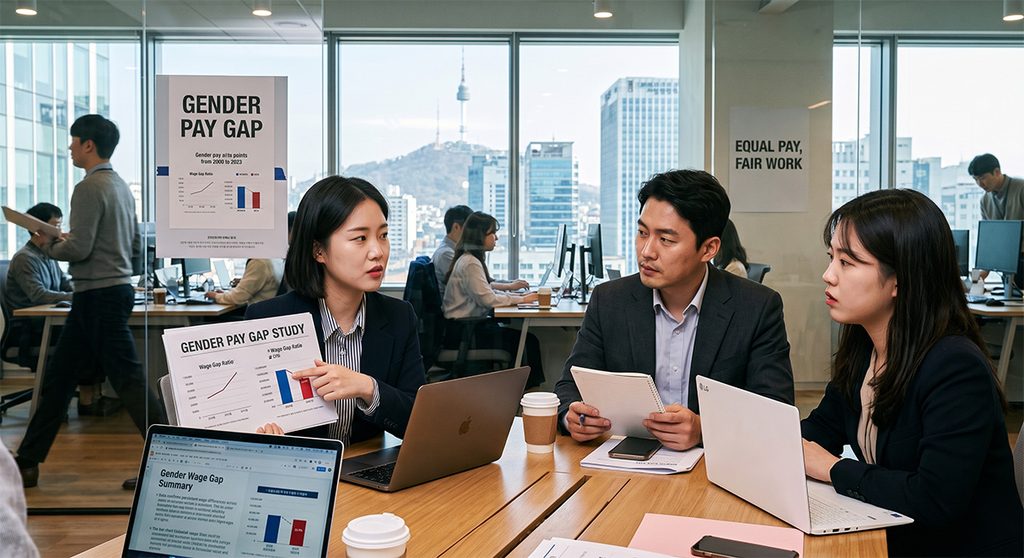
South Korean women earned an average of $2,080 a month in 2024, compared with $3,210 for men, a $1,130 difference that helps explain why one of the world’s most advanced economies continues to have an unusually large gender pay gap.
The numbers do not mean Korean companies simply pay a woman 35% less than a man for doing the same job. They reflect something broader about the country’s labor market. Women are far more concentrated in lower paying jobs, become less common as salaries rise and are more likely to see their careers interrupted during the years when pay and seniority begin to accelerate.
That distinction matters as South Korea confronts a shrinking workforce. The country is a critical part of global semiconductor, automobile and manufacturing supply chains, but its long term economic capacity increasingly depends on making better use of the workers it already has. A labor market that loses women from established career tracks and brings many of them back into lower paying positions therefore becomes an issue of labor supply and productivity as much as one of gender equality.
An analysis released by the Korean Women’s Development Institute, a policy research organization focused on women and labor issues, showed women’s average monthly wages were 64.8% of men’s in 2024.
The divide becomes clearer further up the income scale. At workplaces with at least five employees, 57.1% of women earned less than $2,190 a month, compared with 25.1% of men. Among workers earning at least $3,650, the pattern flipped. Men accounted for a much larger share, with 37.2% of male workers reaching that income level compared with 14.5% of women.
Women made up 70.7% of workers earning less than $1,460 a month. Their share declined to 57.8% among those earning between $1,460 and $2,190, then to 38.0% between $2,190 and $2,920. Women represented just 21.1% of workers earning at least $3,650.
Part of the explanation lies in where men and women work and how their careers develop.
Women in South Korea remain heavily represented in sectors such as health, social welfare and education, while they are less represented in some of the higher paying parts of the labor market. In health and social welfare services, women earned an average of $1,990 a month, compared with $3,695 for men. Their average pay was just 54.0% of men’s.
The gap was also visible by occupation. Women in sales earned 60.4% of men’s average pay, while women in service occupations earned 61.2%. Female professionals and related workers earned 63.0%. Among managers, however, women earned 84.7% of men’s average pay.
Career interruptions deepen those differences. OECD research has found that childbirth and child care continue to cause significant breaks in women’s employment in South Korea. That carries an unusually large cost in a corporate system where length of service has traditionally played an important role in determining wages and advancement.
A woman who leaves a regular job for several years can therefore lose more than the income she would have earned during that period. She can also lose seniority and future wage growth. Women returning to the workforce after raising children are also more likely to enter lower paying nonregular employment rather than return to the career track they left.
That dynamic is reinforced by South Korea’s divided labor market. Regular employees generally have greater job security and stronger wage progression, while nonregular workers typically have less security and weaker earnings growth. Women who move from the first group into the second after a career interruption can carry that income penalty for years.
The government statistics themselves do not attempt to measure how much of the $1,130 monthly difference comes from each factor. Differences in occupation, position, tenure and working hours are all reflected in the averages, meaning the figures cannot be interpreted as a direct measure of unequal pay for identical work.
The result, however, is striking even among other wealthy countries. South Korea’s gender pay gap was 29.0% in 2024, compared with an OECD average of 10.1%. The gap narrowed to 27.8% last year but remained exceptionally large.
Low wage employment shows the same imbalance. About 23.8% of South Korean women were classified as low wage workers in 2024, compared with an OECD average of 16.9%. The measure covers full time workers earning less than two thirds of the median hourly wage.
The Korean Women’s Development Institute said the gap reflects the concentration of women in lower paying jobs as well as structural differences among industries and occupations.
South Korea is now preparing an employment equality disclosure system that would provide more information about differences in male and female employment and earnings. The government sees greater transparency as one tool for addressing the imbalance.
The larger economic problem will be harder to solve. South Korea’s pay gap has been built not around a single wage decision but across careers, as differences in occupation, seniority, working hours and employment status accumulate over time. As the country’s pool of workers contracts, keeping more women on higher paying career paths is becoming increasingly connected to how much of its available labor South Korea can actually put to work.