Hyundai Motor, one of South Korea’s largest automakers and a global vehicle manufacturer with a growing presence in markets such as the United States, is taking a different approach to the decline of compact sedans. Instead of abandoning smaller cars as consumers shift toward SUVs and electric vehicles, the company is attempting to make them more competitive by adding premium-level safety and convenience technology.
Hyundai introduced the eighth-generation Avante, known as the Elantra in many global markets, on July 29 in Seoul. The redesigned model arrives at a difficult moment for traditional sedans, as buyers worldwide increasingly prioritize larger vehicles with more cargo space and higher seating positions.
The challenge is particularly significant because the Avante has been one of Hyundai’s most important models in South Korea. With more than 16 million units sold globally over 36 years, the compact sedan has become a symbol of affordable mobility in the country and has served as a first vehicle for many Korean drivers.
Rather than competing with SUVs through size alone, Hyundai is trying to compete through technology. The company’s strategy is to bring safety systems and driver assistance features typically associated with higher-priced vehicles into a compact sedan segment where affordability has traditionally been the main selling point.
The new Avante is the first Hyundai model equipped with an emergency braking function connected to its electronic shift-by-wire system. If a driver experiences unintended acceleration, holding down the parking button allows the vehicle to gradually reduce speed. Hyundai said the feature was designed as an additional safety measure for situations where using the conventional brake pedal may be difficult.
The vehicle also includes technology aimed at preventing pedal misapplication accidents, in which drivers mistakenly press the accelerator instead of the brake. The system can limit sudden acceleration and activate braking in certain situations. Hyundai highlighted the growing concern over such incidents, citing insurance industry data showing that pedal misapplication accidents have increased significantly in recent years.
Safety improvements extend beyond electronic systems. Hyundai strengthened the Avante’s body structure by increasing the proportion of ultra-high-strength steel from 52.6% in the previous model to 58.7%. The company said the reinforced structure is designed to better protect passengers by reducing cabin deformation and distributing collision forces more effectively.
The redesign also addresses one of the main reasons consumers move from sedans to SUVs: space. Hyundai expanded the vehicle’s length, width, and wheelbase compared with the previous model, creating an interior closer to what Korean consumers traditionally expect from larger vehicles. The trunk was also redesigned to make loading larger items easier.
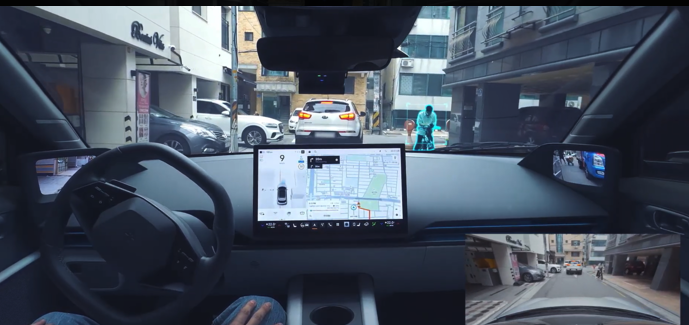
Technology upgrades continue inside the cabin. The new Avante introduces navigation-based Smart Cruise Control, which can automatically adjust speed based on road conditions, including speed-limit zones, speed bumps, and intersections. It also features Memory Rearward Assist, which remembers a vehicle’s previous path in narrow roads and parking areas and helps drivers reverse along that route.
For Hyundai, the latest Avante is more than a product update. It represents an attempt to defend the compact sedan category at a time when much of the global auto industry is moving toward SUVs and electrification. The company is betting that smaller vehicles can remain relevant if they deliver the technology and safety expectations of more expensive models.