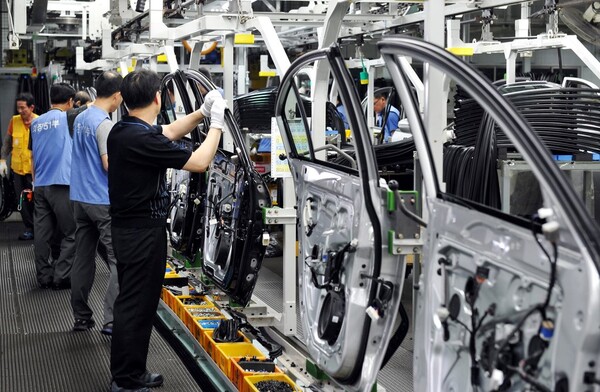
Hyundai Motor Group, the South Korean automotive group whose core automakers are Hyundai Motor and Kia, is expanding production and its electric vehicle lineup in India as the country becomes a larger part of its growth strategy. India has more than 1.4 billion people and has grown into the world’s third largest automobile market, giving automakers room to add sales as vehicle ownership expands alongside the economy.
The next piece of Hyundai’s expansion is not another factory or another vehicle. It is financing. Producing more cars only creates growth if dealers can afford to stock them and customers can afford to buy them. Hyundai Motor Group is now building that financial layer in India through Hyundai Capital, its auto finance company, which provides funding connected to the sale of Hyundai and Kia vehicles.
Hyundai Capital has begun operations in India with dealer financing and plans to move gradually into consumer auto loans, leasing and fleet finance. The strategy effectively extends Hyundai Motor Group’s Indian business beyond manufacturing and vehicle sales into the credit system that helps move cars from factories to dealer lots and eventually to buyers.
That connection is particularly important as Hyundai increases its Indian vehicle business. Hyundai Motor India sold 75,360 vehicles in July across domestic sales and exports, up 25.4% from a year earlier and its highest monthly total since entering the market. Hyundai Motor Group is also expanding local production capacity and strengthening its electric vehicle lineup.
More vehicles flowing through Hyundai and Kia dealerships create a corresponding need for financing. Dealers have to purchase vehicles before selling them, maintain enough inventory to meet demand, expand showrooms and acquire demonstration cars and replacement parts. Without sufficient credit, a larger factory does not necessarily translate into a larger retail business.
Hyundai Capital is starting at that point in the chain.
The company received approval from the Reserve Bank of India in March to operate as a nonbank financial company and converted its existing Indian advisory operation into Hyundai Capital India. The new financial unit is initially relying largely on capital supplied by its headquarters.
Its first products are designed for Hyundai and Kia dealers. Hyundai Capital India is providing inventory financing for vehicles, funding for business expansion and showroom facilities, and loans for demonstration vehicles and parts.
Vehicle inventory financing can run for as long as 360 days. Financing used for business expansion and facilities ranges from 24 to 60 months, while parts financing is available for periods of 60 to 90 days.
Starting with dealers also gives Hyundai Capital something that becomes increasingly valuable as the business grows. It can connect lending decisions directly to vehicle sales data.
Hyundai Capital India has linked its systems with Hyundai Motor and Kia sales and inventory information. That allows the lender to see individual dealers’ sales volumes and vehicle inventories in real time.
The company is using that information in a credit assessment model built around Indian market data. A dealer’s financing limit is determined not only by its financial condition but also by measures such as sales performance and inventory turnover.
If sales begin slowing at a dealership or unsold vehicles start accumulating, Hyundai Capital can identify the change earlier and reflect it in its lending decisions. The same data that show Hyundai and Kia how vehicles are moving through their dealer networks can therefore also be used to manage financial risk.
That creates a tighter link between the automotive and financing sides of the business. Hyundai and Kia produce and distribute the vehicles, dealers use Hyundai Capital financing to carry them, and sales and inventory data flow back into decisions about how much credit those dealers should receive.
Once that dealer finance operation is established, Hyundai Capital plans to move closer to the person ultimately paying for the vehicle.
The company intends to expand into retail financing for individual buyers and later add leasing and fleet finance for corporate customers. It is also considering a digital credit assessment system designed for the Indian market.
Electric vehicle financing is another potential area of expansion. Hyundai Motor Group is adding electric vehicles in India, and Hyundai Capital is considering financial products designed specifically for electric and other environmentally friendly vehicles as its consumer finance business develops.
The strategy means Hyundai is building more than additional vehicle capacity in India. It is developing a system in which manufacturing, dealerships, sales data and financing can support one another as the market grows.
Hyundai Capital still has to build the financial foundation for that system.
During the early stage of its Indian business, the company expects to depend mainly on capital supplied by headquarters. Once Hyundai Capital India secures its own credit rating, it plans to borrow from Indian and international financial institutions and eventually issue corporate bonds.
That funding transition will be important because an auto finance company cannot expand its loan portfolio indefinitely with money supplied by its parent company. A larger dealer and consumer finance business requires stable access to outside capital.
Securing a credit rating and building local funding channels would allow Hyundai Capital India to reduce its reliance on headquarters while increasing the amount of financing it can provide.
The risks will also become broader once the company moves from dealers to individual customers. Dealer financing allows Hyundai Capital to rely partly on detailed sales and inventory information from Hyundai and Kia. Consumer lending will require the company to assess the creditworthiness of a much larger and more diverse group of borrowers.
That makes Hyundai Capital’s entry into India a financial test of Hyundai Motor Group’s broader expansion there. Hyundai has already been increasing the number of vehicles it can produce and sell in the country. It is now building the credit infrastructure needed to make sure dealers can stock those vehicles and, eventually, customers can finance them.
If Hyundai wants India to become a substantially larger automobile business, producing more cars is only the first part of the equation. Financing the path from the factory to the buyer is the next.