
Poland has reaffirmed plans to acquire 1,000 K2 main battle tanks from Hyundai Rotem, a South Korean defense manufacturer affiliated with Hyundai Motor Group, signaling that South Korea’s role in Europe’s military buildup is expanding far beyond emergency wartime purchases.
The confirmation from Poland’s Ministry of National Defence comes as European governments continue investing heavily in new weapons systems following Russia’s invasion of Ukraine. While much of that spending has traditionally flowed to U.S. and European defense contractors, South Korean manufacturers have emerged as major beneficiaries by offering advanced equipment with shorter delivery times and large-scale production capacity.
Polish Deputy Defense Minister Paweł Bejda said Warsaw remains committed to the framework agreement signed with Hyundai Rotem in 2022, which calls for the acquisition of 1,000 K2 tanks and related support vehicles.
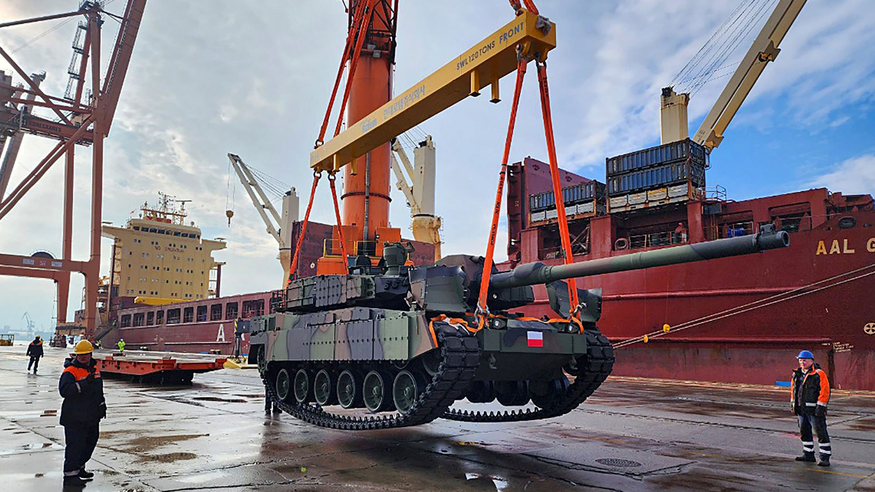
Poland has already completed deliveries of 180 K2GF tanks under the first phase of the agreement. A second contract signed last year covers another 180 tanks scheduled for delivery between 2026 and 2030. According to the Polish government, 116 additional K2GF tanks will arrive in 2026 and 2027, followed by 64 K2PL tanks, a variant customized for Polish military requirements, between 2028 and 2030.
The program’s importance extends beyond the number of tanks involved.
Unlike many traditional arms purchases, the K2 agreement includes extensive technology transfers and plans to establish manufacturing and maintenance capabilities inside Poland. Under the current schedule, the first three K2PL tanks will be produced in South Korea for testing and validation, while the remaining vehicles will be assembled in Poland as part of a localization program designed to build domestic defense-industrial capabilities.
Polish officials also confirmed that support vehicles associated with the K2 platform, including armored recovery vehicles, bridge-layer systems and combat engineering vehicles, will be produced locally.
The arrangement reflects a strategy that has become increasingly common in South Korean defense exports. Rather than limiting contracts to equipment deliveries, companies are pursuing long-term industrial partnerships that include local production, maintenance support and technology sharing.
Poland said cooperation with Hyundai Rotem covers a broad range of technologies, including turret and hull structures, suspension systems, autoloading mechanisms and maintenance capabilities for both K2GF and K2PL variants. Officials added that future exports involving Polish-produced K2 platforms have not been ruled out.
For Hyundai Rotem, the Polish project represents one of the largest overseas defense programs in the company’s history. For South Korea’s defense industry, it serves as another sign that European governments increasingly view Korean manufacturers as strategic suppliers rather than alternative sources of equipment.
That shift has accelerated since the outbreak of war in Ukraine exposed limitations in defense production capacity across Europe. Governments seeking to modernize armed forces and replenish military inventories have increasingly turned to South Korean companies capable of delivering tanks, artillery systems and other weapons on timelines that many Western manufacturers have struggled to match.
The K2 Black Panther has become one of the flagship products of that expansion. Equipped with a 120mm smoothbore gun, advanced fire-control systems, automatic target-tracking technology and active protection systems designed to defeat incoming threats, the tank has helped establish South Korea as a growing force in the global armored vehicle market.
Poland’s decision to move forward with the full 1,000-tank program suggests that South Korea’s defense industry is no longer participating in Europe’s rearmament effort as a temporary supplier. Instead, Korean manufacturers are becoming increasingly integrated into the continent’s long-term military modernization plans through production partnerships, technology transfers and industrial cooperation that extend well beyond a single export deal.