South Korea should be one of the hardest markets in the world for Tesla to crack. It is the home of Hyundai Motor and Kia, two of the largest automakers competing with Tesla in the global electric vehicle market. Instead, Tesla is gaining ground while the country’s domestic manufacturers retreat.
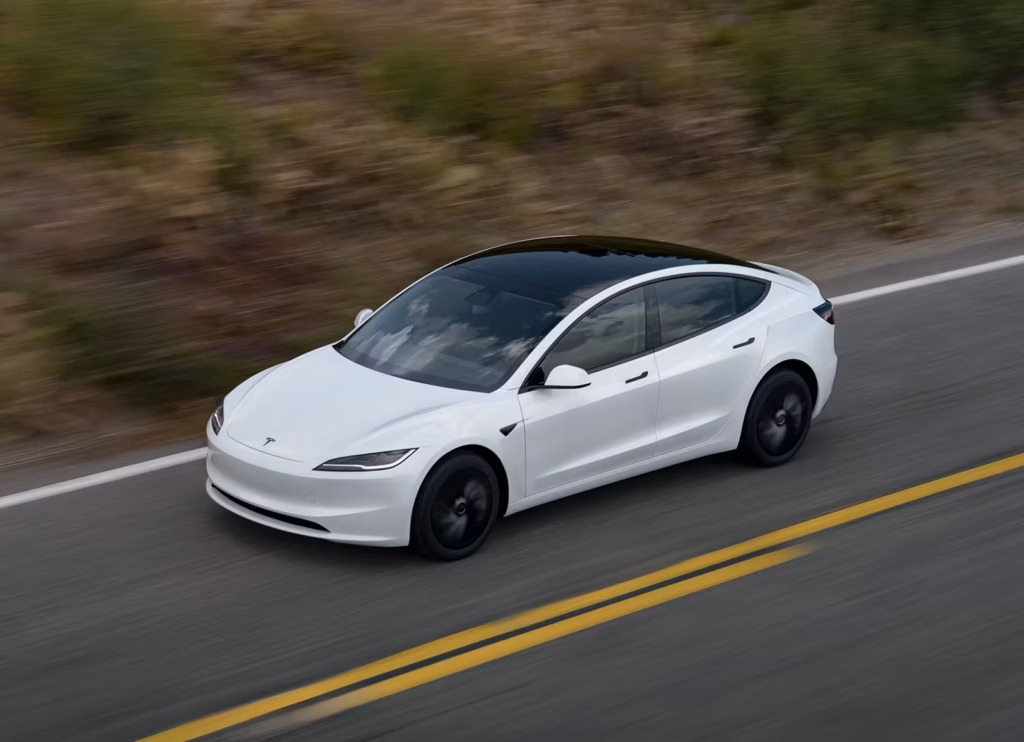
Tesla registrations in South Korea jumped 36.4% in September from a year earlier, while combined domestic sales at the country’s five major automakers fell 19.8%. The result matters beyond Korea because Tesla is doing it largely with Model 3 and Model Y vehicles made in Shanghai. An American automaker is using its Chinese manufacturing base to take market share from Korean rivals on their own turf.
That also makes South Korea a revealing test of industrial policy in the EV era. The government changed its subsidy system to reward companies that contribute more to the domestic supply chain. China’s BYD failed to qualify. Tesla remained eligible, even though the vehicles driving its growth are built in China. The distinction shows how difficult it can be for governments to design incentives around supply chains rather than corporate nationality.
Tesla registered 12,372 vehicles in South Korea in September, up from 9,069 a year earlier, according to the Korea Automobile Importers and Distributors Association.
Hyundai Motor, South Korea’s largest automaker, and Kia were among five domestic manufacturers whose combined home market sales fell to 99,843 vehicles during the month. The group also includes KG Mobility, GM Korea and Renault Korea.
Tesla’s rise was not part of a broader boom in foreign cars. Imported passenger vehicle registrations increased 6.3% to 34,904 in September, but without Tesla they would have fallen 5.2%.
Mercedes Benz registrations dropped 20.7%, Audi declined 36.9%, Lexus fell 24.9% and BMW slipped 8.2%.
The same pattern has played out throughout the year. Imported car registrations increased by 54,381 vehicles during the first nine months. Tesla accounted for 45,536 of those additional registrations, or 83.7% of the market’s growth.
Tesla registered 89,148 vehicles from January through September, giving it 31.9% of South Korea’s imported car market. It has already sold roughly 50% more vehicles than it did during all of last year.
The bigger challenge for Hyundai and Kia is what is happening inside the electric vehicle market.
Hyundai sold 5,435 EVs in South Korea in September, down 27.7% from a year earlier. Tesla registered more than twice that number during the same month.
Korean brands controlled 64.0% of their domestic EV market in 2024. Their share fell to 57.2% in 2025 and could drop below half this year.
South Korea has tried to slow that erosion by directing more public support toward companies that contribute to local manufacturing and supply chains.
Since July, the Ministry of Climate, Energy and Environment has evaluated automakers using five criteria, including supply chain contributions, and requires a minimum score of 60 points to qualify for EV subsidies.
BYD did not make the cut. Tesla did.
That outcome is notable because Tesla’s Model 3 and Model Y sold in South Korea come from its Shanghai factory. The policy succeeded in excluding one Chinese automaker but not Chinese manufactured vehicles sold by an American company.
Sales volume has further diluted the intended advantage for domestic manufacturers.
Industry estimates based on Tesla sales and government published subsidy rates indicate that buyers of Tesla vehicles received about $85 million in national subsidies through the first seven months of the year. That is roughly 12.2% of South Korea’s $700 million electric passenger vehicle subsidy budget.
Tesla receives less than half as much government support per vehicle as Hyundai in some cases. But because Tesla sells more than twice as many vehicles, the difference in total subsidy payments narrowed to about $5 million.
The numbers illustrate the problem facing policymakers. Cutting the subsidy on each imported vehicle does not necessarily protect domestic manufacturers if the imported vehicle sells in much greater volume.
Tesla has also been willing to replace some government support with its own money.
Roughly 90% of South Korea’s EV subsidy budget had been used by the end of August. In regions where public subsidies were exhausted, Tesla Korea offered customers as much as $1,600 toward vehicles delivered by Sept. 30.
The approaching deadline appears to have helped push September registrations higher.
The final three months of the year will therefore offer a different test. As subsidies become harder to obtain, Tesla, Hyundai and Kia will increasingly have to compete without the same level of government support.
What happens next will say more than who sells the most EVs in South Korea. Hyundai and Kia are major competitors in the U.S. electric vehicle market, while Tesla’s Shanghai plant has become an important base for supplying markets outside China. South Korea is now showing what happens when those two strategies collide.
So far, the advantage is going to Tesla. Its success suggests that a global manufacturing network spanning the U.S. and China can overcome many of the advantages traditionally enjoyed by domestic automakers, including local production, established distribution and government incentives designed partly around domestic supply chains.