South Korea requires most able bodied men to serve in the military. The Korean War ended with an armistice in 1953 rather than a peace treaty, and the country has maintained conscription while facing North Korea across the border. For young South Korean men, that can mean putting college, a job or a professional career on hold for 18 to 21 months.
That system increasingly reaches far beyond South Korea. Korean singers sell out arenas in the U.S., baseball players pursue careers in Major League Baseball and golfers compete on the PGA Tour. Whether a performer or athlete must leave a career for military service can affect tours, contracts, transfers and the years in which that person has the greatest commercial value. BTS demonstrated the scale of that disruption when its seven members stepped away from full group activity to complete their military obligations before reuniting.
Yet South Korea does not require every elite athlete to follow the same path.
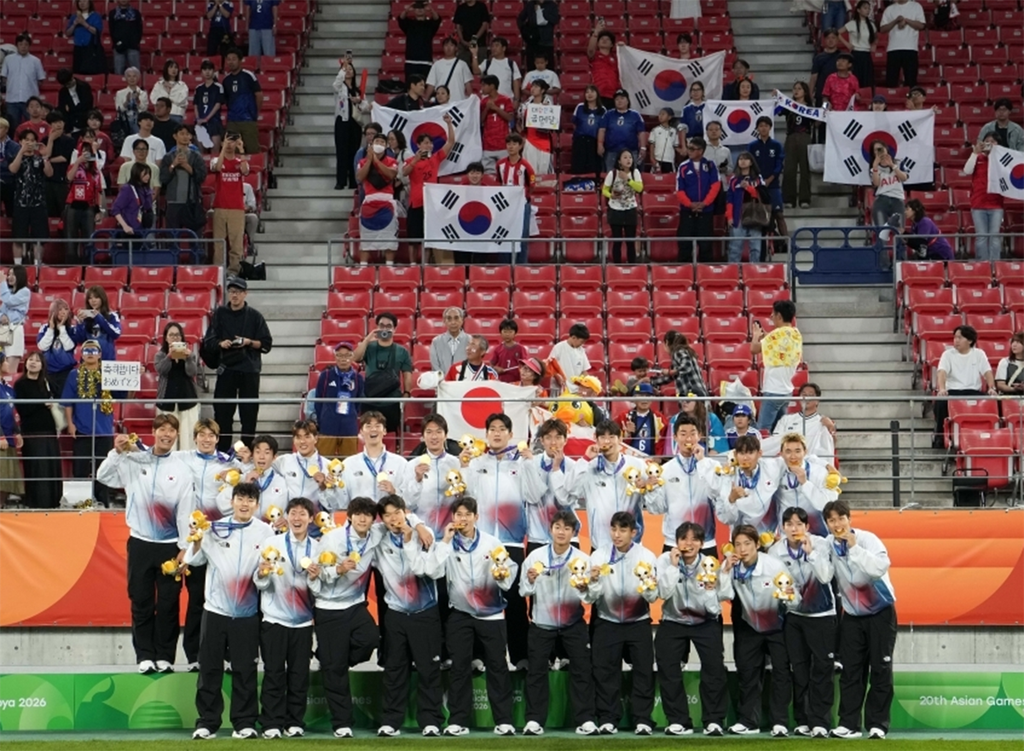
At the 2026 Aichi Nagoya Asian Games in Japan, South Korea won its fifth consecutive baseball gold medal and its fourth straight title in men’s soccer. The victories also made players who had not yet completed their military obligations eligible for a special form of service reserved for elite athletes. South Korea’s men defeated Japan 1 to 0 in the soccer final, while the baseball team also beat Japan for gold.
The athletes themselves are not the problem. They competed under rules established by the government and qualified for a benefit available under those rules.
The harder question is whether the rules still make sense.
South Korea created its arts and sports personnel system in 1973 for artists and athletes whose achievements were considered contributions to national prestige and cultural development. Today, Olympic medalists and Asian Games gold medalists can qualify.
Instead of conventional active duty, they serve for 34 months in their professional fields and must complete public service requirements.
For a professional athlete, that distinction can change an entire career.
A soccer player can pursue an overseas contract without the same risk of leaving his club for active military duty. A baseball player can continue developing through years that might otherwise be interrupted. At the latest Asian Games, PGA Tour golfer Tom Kim also secured the alternative service status by winning the men’s individual gold medal.
That is where the system becomes difficult to explain.
An Asian Games gold medal qualifies. A comparable result at many world championships does not. The Asian Games itself changes over time as sports and events are added or removed. An international sports body can determine which events belong in the competition, while South Korea then attaches consequences for military service to the results.
The connection between national team selection and military benefits creates another problem.
International tournaments can overlap with professional league seasons. Coaches and sports organizations may have to consider club commitments, schedules and player availability when choosing a national team. Athletic ability remains central, but it is not necessarily the only practical factor involved.
That means selection for one tournament can help determine whether a young man later serves in the conventional military system or follows a substantially different path.
South Korea has struggled with that distinction before.
Players from the national soccer team that reached the semifinals of the 2002 World Cup and the baseball team that reached the semifinals of the 2006 World Baseball Classic received special treatment. Those tournament specific provisions were eventually removed amid arguments that military rules should not change whenever a national team produced an exceptional result. The current system again limits athletic qualification to Olympic medalists and Asian Games gold medalists.
Then BTS made the contradiction much harder to ignore.
The group became one of South Korea’s most internationally successful cultural exports, building a huge American audience and turning K pop into a major part of the global music business. Its success led to years of debate over whether major popular culture artists should also be allowed to qualify for alternative military service.
South Korea ultimately decided not to create that new route.
All seven BTS members fulfilled their military obligations, with the final member completing service in 2025.
That decision did not resolve the fairness question. It shifted the question toward the exemptions that already existed.
If worldwide cultural success was not sufficient to justify creating a different military path for BTS, why should a gold medal at one particular sporting competition continue to provide one for an athlete?
The answer was easier to defend when the system was created more than half a century ago. South Korea in 1973 had a much smaller global presence, and a major international sporting or artistic achievement could provide rare international visibility.
That is no longer the country South Korea has become.
Its musicians fill American stadiums. Its semiconductor and electronics industries sit inside global supply chains. Korean films and television shows reach international audiences, while its scientists, engineers and entrepreneurs contribute to the country’s reputation abroad.
Extending military benefits to everyone who raises South Korea’s international standing would not solve the problem. It would create another one.
The government would have to decide whether a musician, scientist, athlete or entrepreneur had contributed more to the country. The definition of national prestige could expand almost indefinitely.
The more fundamental question is whether national prestige should still determine how someone fulfills a military obligation in the first place.
That question is becoming harder to avoid as South Korea runs short of young men.
The country’s active duty military has already declined substantially as the population of military age men contracts. A few dozen athletes moving into active duty would not solve South Korea’s manpower problem. The government itself has previously argued that the relatively small number of people qualifying for the program means abolishing it would have little effect on total troop levels.
But the numbers are not the only issue.
Military service asks young men to give up a meaningful part of the period when they are studying, beginning careers and establishing financial independence. When the state allows a small group to fulfill that obligation under dramatically different conditions, the reason must be clear enough to sustain confidence in the broader system.
The demographic decline makes that standard more important, not less.
South Korea has already had years to confront the issue. Controversy followed the 2018 Jakarta Palembang Asian Games. The BTS debate brought it back into national attention. Now the 2026 Asian Games has produced another round of criticism, including renewed comparisons with BTS as South Koreans question whether the decades old system still reflects the country it was designed to serve.
Reform does not necessarily require choosing between keeping every exemption and eliminating every accommodation.
One option would be to move away from allowing a single international competition to carry so much weight. A cumulative system could evaluate sustained performance across several major competitions rather than allowing one gold medal to determine eligibility.
That approach would bring its own complications. Sports have different competitive structures, and governments would still have to decide which tournaments deserve recognition and how much each achievement should count.
A more fundamental alternative would separate protection of a short professional career from exemption from conventional military service.
Elite athletes and performers often have narrow windows in which they can compete or perform at their highest level. South Korea could allow people who meet clearly established standards to postpone service during those years and require them to fulfill their military obligations afterward.
That would address the career problem without requiring the government to decide that one form of international success deserves a fundamentally different military obligation.
Gold medals should be rewarded. Athletes who represent their country and reach the highest levels of international competition deserve recognition for what they accomplish.
But rewarding achievement and determining military obligations are not necessarily the same thing.
South Korea has debated that distinction after the World Cup, after the World Baseball Classic, after the 2018 Asian Games and during the BTS controversy. The latest Asian Games has returned the country to the same unresolved question.
The issue is no longer whether BTS should have received the treatment available to a gold medalist or whether another group should be added to the system.
It is whether South Korea still has a convincing reason for using a standard created in 1973 to decide whose career should be protected from the disruption of active military service.