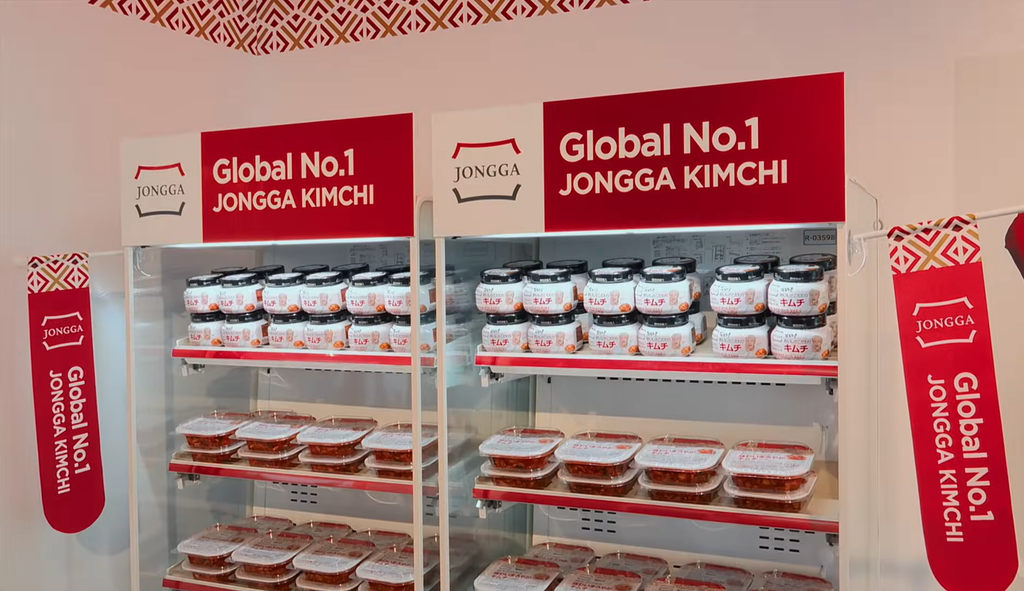
Jongga, the flagship kimchi brand of South Korean food company Daesang, is making a bigger push into the United States as growing interest in Korean food creates an opening beyond Asian grocery stores.
The U.S. has already become Jongga’s largest export market, surpassing Japan in 2023. That has pushed the brand to do more than ship Korean-made kimchi across the Pacific. Jongga is increasingly being produced with American-grown ingredients, manufactured in California and distributed through a broader U.S. retail network.
That shift is what makes Jongga’s expansion more significant than another K-food export story. The brand is testing whether kimchi can move from a Korean specialty into a regular part of the American grocery business, while Daesang builds the local manufacturing and supply chain needed to support that transition.
Daesang opened a large kimchi plant in City of Industry, California, near Los Angeles, in 2022. The facility can produce about 2,000 metric tons of kimchi a year and makes several Jongga products, including Original Kimchi, Vegan Kimchi, White Kimchi, extra-spicy Silbi Kimchi and Cucumber Kimchi.
Jongga has also localized much of its ingredient supply. Napa cabbage, radishes and green onions are sourced in the United States, allowing the brand to produce closer to American consumers instead of relying entirely on ingredients and finished products shipped from South Korea.
Daesang expanded that U.S. footprint again in 2023 by acquiring Lucky Foods, an American food manufacturer whose products include Seoul Kimchi. The acquisition added local production capacity and distribution reach, giving Jongga access to a broader U.S. operating base that includes manufacturing, sales and logistics.
The brand is also changing what kimchi looks like for American shoppers. Alongside traditional napa cabbage kimchi, Jongga has introduced products made with green cabbage, carrots and cucumbers, as well as milder White Kimchi and ABC Kimchi made with apples, beets and carrots.
Other products go even further from the traditional Korean table. Jongga has developed kimchi spread for bread and crackers and Crunchy Bites built around a crisp texture, an effort to make kimchi easier to use within eating habits that already exist in the U.S.
Jongga has also tried to build recognition outside Korean supermarkets. In 2024, the brand partnered with Korean American chef Corey Lee to launch two San Ho Won kimchi products in the U.S. under its Gourmet Edition line. It has also operated food trucks in Los Angeles and New York and appeared at the Head in the Clouds music festival in Los Angeles.
The push comes as Jongga’s overseas business continues to grow. Its kimchi exports increased from about $32 million in 2017 to $90 million in 2025. In the first half of 2026, Jongga accounted for about $48 million of South Korea’s roughly $86 million in kimchi exports, according to figures cited by Daesang.
Daesang is turning the U.S. into more than an export market for Jongga. By producing kimchi locally, sourcing American ingredients and developing products around U.S. eating habits, the South Korean food company is trying to establish Jongga as a more familiar name on American grocery shelves.