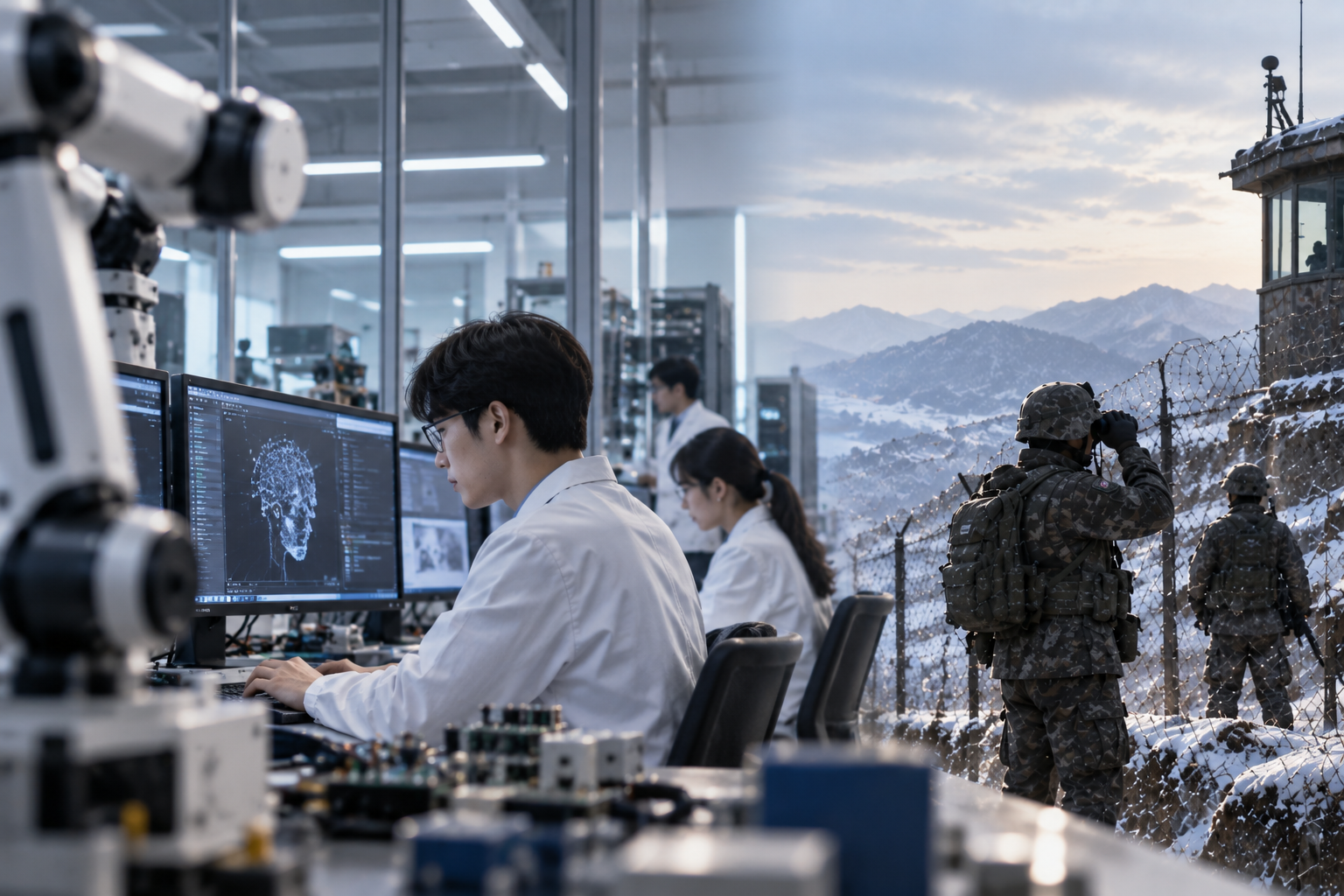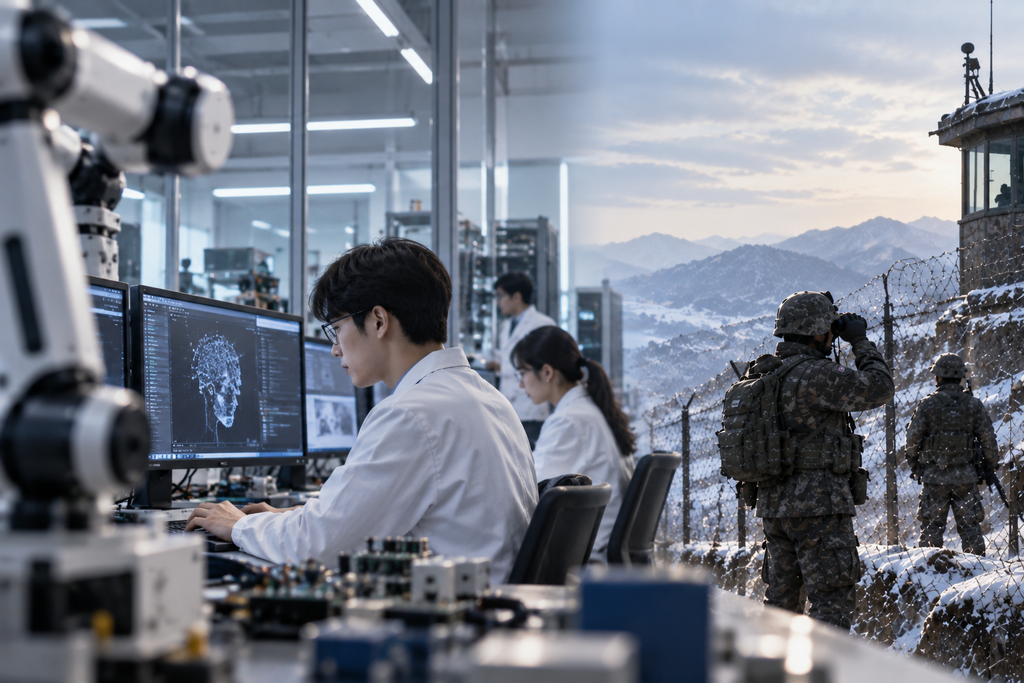
South Korea is reopening the doors of its biggest corporate laboratories to young men fulfilling mandatory military service, reviving a program after 14 years as the country tries to keep artificial intelligence researchers from stepping away from their careers at a critical moment in the global technology race.
The arrangement can look unusual from the United States, where technology companies do not have to plan around compulsory military service for young male engineers. South Korea does. Its constitution imposes a national defense obligation, and the country’s Military Service Act requires male citizens to perform military service. The system remains rooted in the security reality of the Korean Peninsula, where the Korean War ended with an armistice in 1953 and no peace treaty has ever replaced it.
That means a young Korean engineer can spend years earning an advanced degree in AI or another technical field only to face a mandatory interruption just as his research career is beginning. The government is now making a limited calculation that some of those men may serve the country more effectively by continuing to develop technology than by leaving their laboratories for conventional military duty.
Beginning in 2027, qualifying AI researchers will again be able to fulfill their military obligation at research institutes run by some of South Korea’s largest companies. The Ministry of Science and ICT has recommended nine laboratories operated by Samsung Electronics, LG Electronics, HD Hyundai Robotics and Samsung Medison. Together, they have requested 81 researchers.
The companies are not receiving free conscript labor because they cannot afford to hire engineers. Samsung Electronics is South Korea’s largest electronics and semiconductor manufacturer, LG Electronics is one of the country’s major consumer electronics companies, HD Hyundai Robotics develops industrial robots, and Samsung Medison makes medical imaging equipment. The issue is not whether these companies can pay researchers. It is whether the researchers they recruit can continue working without military service pulling them away from fast moving technical fields.
South Korea’s Professional Research Personnel system offers that alternative. Qualified science and engineering researchers perform their military obligation by conducting research at approved institutions for three years instead of serving through the conventional military route. They remain researchers rather than becoming ordinary soldiers. Military Manpower Administration job listings for the program show that these are paid employment positions with salaries and normal working conditions.
That creates an obvious attraction for the individual researcher. A young AI specialist who qualifies can continue earning a salary, accumulate professional experience and work with advanced research infrastructure instead of putting his technical career on hold. The tradeoff is that the research service lasts three years.
The same arrangement gives companies something increasingly valuable in the AI race. It reduces the chance that young researchers disappear from laboratories during a period when skills in artificial intelligence, semiconductors and robotics can become outdated quickly and when technology companies around the world are competing for a limited pool of specialists.
South Korea once decided that its biggest corporations should not receive that advantage. New Professional Research Personnel allocations to large companies were stopped in 2013, partly because the government wanted scarce research and development talent to flow toward smaller companies that had more difficulty attracting engineers. That also closed the military service route through laboratories at companies such as Samsung and LG.
AI has changed the calculation.
The government has now created a temporary exception for the technology. Starting in 2027, 120 positions a year will be available to qualifying large corporate AI research institutes, with the program scheduled to run through 2029. Another 120 positions are allocated to government funded and defense related research institutions, bringing the annual AI allocation under the program to 240.
The shift matters beyond the relatively small number of researchers involved. South Korea is a major producer of semiconductors, electronics and industrial technology, and companies such as Samsung compete directly with American and other global technology businesses. The government is effectively treating the potential loss of young AI researchers to mandatory military service as an industrial competitiveness problem rather than simply a personnel issue.
It is also trying to prevent those researchers from taking another path altogether. One of the arguments behind restoring the program has been that forcing young scientists to interrupt their research can contribute to career disruption and the loss of skilled workers overseas. Keeping researchers inside advanced domestic laboratories gives them another reason to build their careers in South Korea.
The government is still keeping the door narrow. The nine recommended laboratories requested only 81 of the 120 positions available to large companies, or 67.5 percent of the annual quota. Other large companies applied but failed to satisfy the requirements.
To qualify, a large company must invest at least 5 percent of its revenue in research and development, operate in a field that does not directly compete with small and midsize businesses and demonstrate measurable research achievements. The Military Manpower Administration still must make the final selections and determine allocations, so the 81 requested positions are not guaranteed.
Rep. Hwang Jeong a of the Democratic Party, who obtained the government data, said restoring the program gives young researchers another opportunity to fulfill their military obligation while using some of the country’s most advanced research infrastructure. She also argued that rigid eligibility requirements could limit the program’s effectiveness.
The experiment ultimately reflects a difficult choice created by South Korea’s circumstances. The country still relies on compulsory military service to maintain its defenses, but it is also competing in an AI race in which losing even a few years of research can matter.
South Korea is not excusing its AI engineers from their national obligation. It is changing what serving the country can mean, allowing a small number of them to spend three years building artificial intelligence inside a laboratory instead of leaving their careers behind.