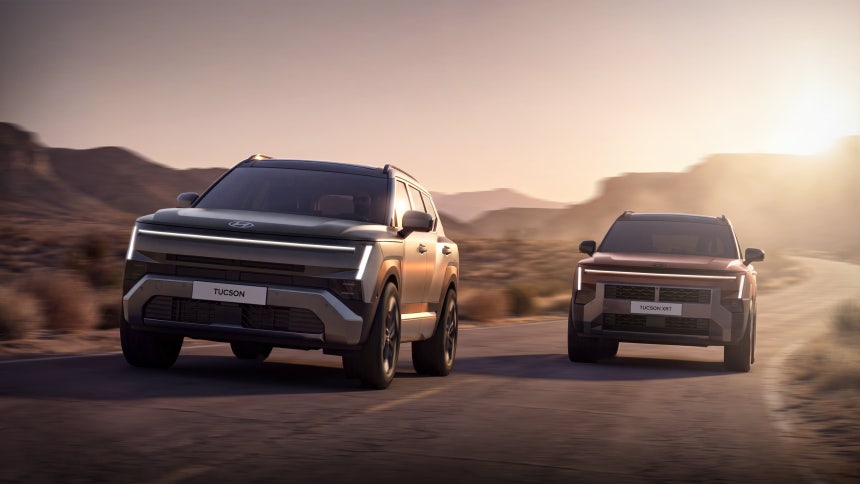
Hyundai Motor is betting that buyers will pay for more space, better hybrid efficiency and increasingly sophisticated vehicle software as the global compact-SUV market evolves beyond traditional measures of performance and utility. For U.S. automakers, suppliers and investors watching the segment, the redesigned Tucson highlights a broader industry shift toward electrified powertrains, larger cabins and software features as competitive differentiators.
Hyundai unveiled the fifth-generation Tucson on September 18, marking the model’s first full redesign in six years. The company plans to announce pricing and begin sales in South Korea in October, with the Tucson continuing to serve as one of Hyundai Motor Group’s key global volume models.
The Tucson has sold more than 10.6 million units worldwide since its launch in 2004, making it the group’s second-best-selling nameplate after the Elantra.
The new model is 185.0 inches long and 72.0 inches wide, gaining about 2.4 inches in length and 1.6 inches in width. Its wheelbase has grown to 109.6 inches, about 1.2 inches longer than before.
Hyundai says the larger dimensions translate into a roomier second row and greater cargo flexibility. Cargo capacity has increased by about 6.1 gallons, while folding the rear seats creates a flatter load floor for larger items.
The added size and equipment come with a weight penalty of about 176 pounds, putting greater importance on powertrain efficiency.
Hybrid Efficiency Improves as Vehicle Gets Larger
The gasoline Tucson uses a 1.6-liter turbocharged engine producing 193 horsepower, 13 horsepower more than the outgoing model. Its combined fuel economy, however, falls to about 28.7 miles per gallon from roughly 29.4 mpg as the vehicle gets heavier.
The hybrid model takes a different approach. Hyundai’s next-generation hybrid system increases the amount of driving that can be handled by the electric motor and improves regenerative braking, which recovers energy during deceleration.
The result is 245 horsepower, 10 horsepower more than the previous model, while combined fuel economy rises to about 40.9 mpg from roughly 38.1 mpg.
The lineup will consist of the 1.6-liter turbo gasoline and 1.6-liter turbo hybrid powertrains, along with an XRT trim aimed at buyers seeking a more rugged, outdoors-oriented design.
For the broader auto industry, the hybrid’s improved efficiency illustrates the growing importance of squeezing more fuel economy from larger vehicles without requiring consumers to move directly to a fully electric model.
Hyundai has moved the Tucson’s styling in a more angular direction, with pronounced fenders, a longer hood and sharply defined lighting.
The company calls the design language “Art of Steel,” emphasizing the sculptural properties of the vehicle’s metal body. The prominent wheel arches are intended to give the SUV a wider, more muscular stance.
The lighting system is also designed to enhance the vehicle’s perceived width. Vertical elements stretch toward the outer edges of the front fascia, while the rear lamps use faceted patterns inside transparent lenses to create a three-dimensional effect.
The more significant competitive shift may be inside the cabin, where Hyundai is integrating software more deeply into the driving experience.
Higher trims feature a 17-inch center display, while the base model uses a 12.9-inch screen. Hyundai has retained physical controls for key driving functions, balancing the larger touchscreen with more traditional interfaces.
The Tucson is Hyundai’s first SUV to feature Pleos Connect, a new infotainment platform that lets drivers download and use applications directly through the vehicle rather than relying exclusively on a connected smartphone.
Hyundai’s generative-AI assistant, Gleo AI, can respond to voice commands, operate vehicle functions and answer questions while maintaining context from earlier exchanges.
The company is also adding features designed to address specific driving situations. Reverse Memory Assist can remember a path through a narrow passage and automatically steer the vehicle along that route when reversing, covering up to about 98 feet.
A redundant power system can unlock the doors if the primary electrical system is disabled. Hybrid versions also get a Stay Mode that allows the air-conditioning and audio systems to operate for about 30 minutes after the engine is switched off.
The Tucson’s redesign reflects a competitive landscape in which automakers are increasingly combining traditional SUV attributes—space, power and styling—with hybrid efficiency and software-defined features. For investors, the model offers a snapshot of where mainstream vehicle development is heading as automakers seek to raise technology content and improve efficiency without abandoning the high-volume SUV segments that remain central to the global auto business.