The artificial intelligence boom has created enormous demand for chips, models and corporate software. The harder question now is whether companies outside the technology industry can turn those tools into measurable gains in the physical economy. One of the clearest tests is emerging not in Silicon Valley but inside a South Korean automaker.
Hyundai Motor Group, the South Korean industrial group behind Hyundai Motor and Kia, is pushing AI through vehicle development, factories, maintenance operations and customer service as it prepares for a longer term shift toward physical AI. Instead of treating generative AI mainly as a tool for writing documents or answering employee questions, Hyundai is trying to use it to shorten engineering work, reduce production stoppages and eventually connect intelligence directly to cars, robots and manufacturing equipment.
That is what makes the experiment significant beyond Hyundai. American technology companies have spent heavily developing the computing infrastructure and models behind the AI boom. Hyundai offers a real world test of what happens when those technologies reach a large manufacturer and are judged not by the quality of a chatbot but by costs, development speed and factory productivity. Hyundai says one AI system is already saving about $37 million annually across roughly 70 production sites, while other applications have reduced certain engineering work by about 90%, production interruptions by 86% and maintenance response times by 42%.
Hyundai detailed the effort on Aug. 12 at its headquarters in Seoul, where employees from research and development, manufacturing, service and digital operations presented the results of the group’s transition from conventional digital transformation to what it calls AI transformation.
The push predates the generative AI boom. Euisun Chung, executive chair of Hyundai Motor Group, began pressing the organization toward a more technology driven operating model in 2018, saying the automaker should become more like an information technology company. Hyundai subsequently introduced collaboration platforms including Jira, Dooray and Confluence before expanding Microsoft’s M365 platform and creating a global data pipeline intended to standardize information scattered across its businesses.
That sequencing is important to Hyundai’s strategy. Generative AI arrived after years of work connecting employees and organizing corporate data, rather than being placed on top of isolated systems.
Even research groups operating under strict security requirements, including autonomous driving and hydrogen teams, were brought onto common platforms after Hyundai secured government guidelines allowing them to do so. The company says that helped remove information barriers between departments and created the data foundation for broader AI use.
Hyundai then built H Chat Pro, an internal generative AI system that allows employees to use models including ChatGPT, Gemini and Claude within a protected corporate environment.
More than 30,000 general office and research employees had registered for the system as of July, representing about 80% of those workers. They are using it for documents, data analysis and software development. Beginning next year, Hyundai plans to expand access so employees across the organization can create AI agents for their own jobs.
The strategy also provides an early look at a problem likely to grow as companies move from AI that produces answers to AI that can take actions.
A Hyundai employee without a traditional software development background created an AI agent that deleted documents from an internal shared system. Rather than ending the experiment, Hyundai executives brought the case to Jensen Huang, chief executive of the American chip company Nvidia, during his visit to South Korea in June.
Jin Eun-sook, president and head of information and communication technology at Hyundai Motor and Kia, said Hyundai openly shared the failure because a company experimenting aggressively with new technology should expect mistakes. She said global companies including Nvidia are also struggling to determine appropriate controls for AI agents.
One idea discussed with Huang was to place potentially unsafe agents inside isolated environments where companies can observe their behavior before allowing them broader access to corporate systems.
That episode exposes a second issue behind the corporate AI boom. The potential economic value of AI agents comes partly from giving software permission to perform work rather than merely recommend it. The more authority companies give those systems, however, the greater the consequences when they behave incorrectly. Hyundai is trying to expand employee access while developing the controls necessary to prevent an efficiency tool from becoming an operational risk.
The company is also trying to impose financial discipline on where AI is used. Hyundai says it does not intend to use artificial intelligence when a conventional algorithm can perform the same task more efficiently.
Its manufacturing results show why that distinction matters.
At Hyundai’s Namyang research center in South Korea, a crash safety AI assistant searches previous test data and identifies similar cases. Hyundai says the system has reduced the time required for that work by about 90%, leaving engineers more time for vehicle design.
The company is combining such employee driven projects with larger initiatives intended to shorten the overall vehicle development process.
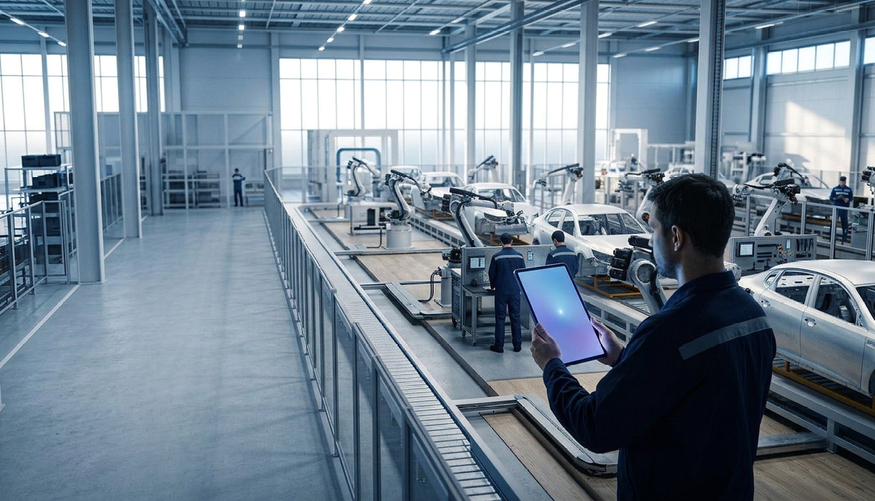
Across about 70 production sites in South Korea and other countries, an automated recognition system uses computer vision to read vehicle identification numbers. Hyundai estimates the technology saves approximately $37 million each year.
Another system designed to optimize vehicle alignment in complex production processes has reduced manufacturing interruptions by 86%. Hyundai’s E FOREST POLARIS manufacturing platform is meanwhile being used to turn knowledge held by factory workers into digital information that can be retained and shared across the organization.
AI is also moving downstream into vehicle maintenance.
A service system allows technicians to describe vehicle symptoms in natural language and combines that information with manuals and historical repair records to generate diagnostic recommendations. Hyundai says it has reduced maintenance response times by 42%.
Customer reviews are being automated as well. Hyundai says AI can analyze reviews submitted through mobile applications and prepare draft responses in about five minutes. The company plans to automate more of the review response process beginning in September so employees can spend more time analyzing customer experience and planning service improvements.
Taken together, the projects make Hyundai more than another corporation experimenting with a chatbot. They provide an example of how the AI investment cycle could spread from technology companies into capital intensive industries where returns can be measured through engineering hours, factory downtime and operating costs.
They also raise a competitive question for the auto industry. If one manufacturer can use AI to shorten development work, preserve factory knowledge and reduce production disruptions, rivals adopting the technology more slowly could eventually face a disadvantage that has little to do with the specifications of the cars themselves.
Hyundai’s longer term ambition makes that question larger. The company wants the data and operating experience accumulated through its internal AI projects to support physical AI, where software intelligence becomes connected to vehicles, robotics and manufacturing systems.
Jin said the decisive factor will not be the technology itself but how quickly a company can absorb new technology and deploy it in real operations.
Whether Hyundai can turn those individual productivity gains into a lasting improvement in its broader financial performance remains unproven. The company has disclosed savings and efficiency gains from specific applications, not evidence that AI has transformed profitability across the entire group.
But Hyundai is already testing the question that matters increasingly to both manufacturers and the technology companies supplying them. The first stage of the AI boom was about what increasingly powerful models could generate on a screen. The next may be about what those models can save, build and eventually control on the factory floor.