South Korea’s largest labor federation pushed back against criticism of its opposition to Hyundai Motor Group’s adoption of humanoid robots, saying it is not resisting technological progress but calling for broader discussion on the impact of automation on jobs.
Yang Kyung-soo, chairman of the Korean Confederation of Trade Unions (KCTU), said on Feb. 5, local time in South Korea, that the union’s stance on Hyundai’s humanoid robot Atlas reflects concerns over employment disruption rather than hostility toward innovation.
“Atlas came as a shock to many workers,” Yang said at a New Year press briefing. “The introduction of artificial intelligence and humanoid robots will not stop at manufacturing and is likely to expand rapidly across industries, putting jobs at risk.”
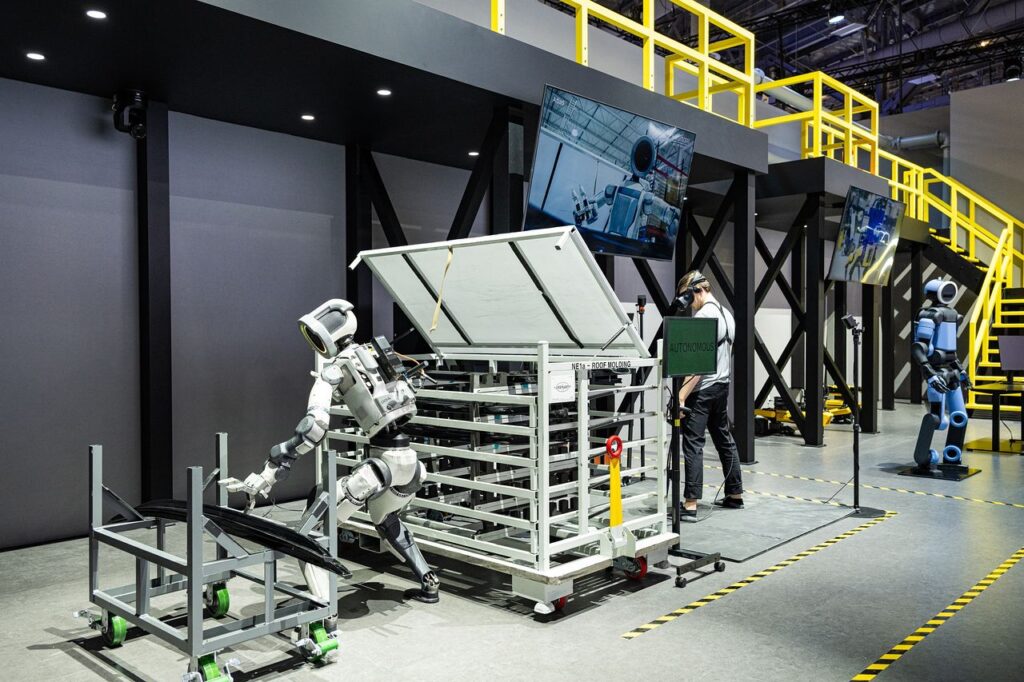
Atlas is a humanoid robot developed by Boston Dynamics, Hyundai Motor Group’s robotics subsidiary, and was unveiled publicly in early January. Designed to walk upright and perform production tasks using articulated joints, the robot is expected to play a role in future factory automation.
Hyundai Motor’s labor union has strongly opposed the deployment of robots on production lines, declaring that no robots should be introduced without prior agreement with workers.
Yang emphasized that labor-management consensus should be a prerequisite for major technological change in the workplace. “Neither the KCTU nor Hyundai’s union is trying to block AI or technological advancement,” he said. “But whether it is automation or robotics, there must be sufficient discussion about how labor will be affected and what alternatives exist.”
He also called for what he described as a “labor impact assessment,” modeled on environmental impact reviews, to evaluate how new technologies and policies could affect employment and industrial ecosystems before implementation.
As robots and AI systems increasingly enter Korean workplaces, debate over job displacement has intensified beyond Hyundai and spread across multiple sectors.
Separately, Yang outlined the KCTU’s broader labor agenda ahead of the implementation of revisions to South Korea’s labor law—often referred to as the “Yellow Envelope Act”—scheduled to take effect on Mar. 10. The changes would allow subcontracted workers to negotiate directly with parent companies, but the KCTU opposes related enforcement rules and administrative guidelines, arguing they weaken bargaining rights and limit employer responsibility.
The federation plans to escalate protests in the coming months, including a national rally on Mar. 10, sector-wide demonstrations in April, and a potential general strike in July aimed at securing broader collective bargaining rights.
Yang ruled out participation in South Korea’s Economic, Social and Labor Council, saying the body has become a vehicle for implementing government policy rather than reflecting workers’ interests. The KCTU has not taken part in formal government-led social dialogue since 1999.
“The structure itself no longer represents labor,” Yang said. “Our position on this has been consistent.”