The rapid spread of small, inexpensive attack drones has begun to erode one of the most enduring assumptions of modern ground combat: that heavy armor can reliably protect tanks on the battlefield. As militaries search for ways to adapt, South Korea is testing a blunt but immediate response.
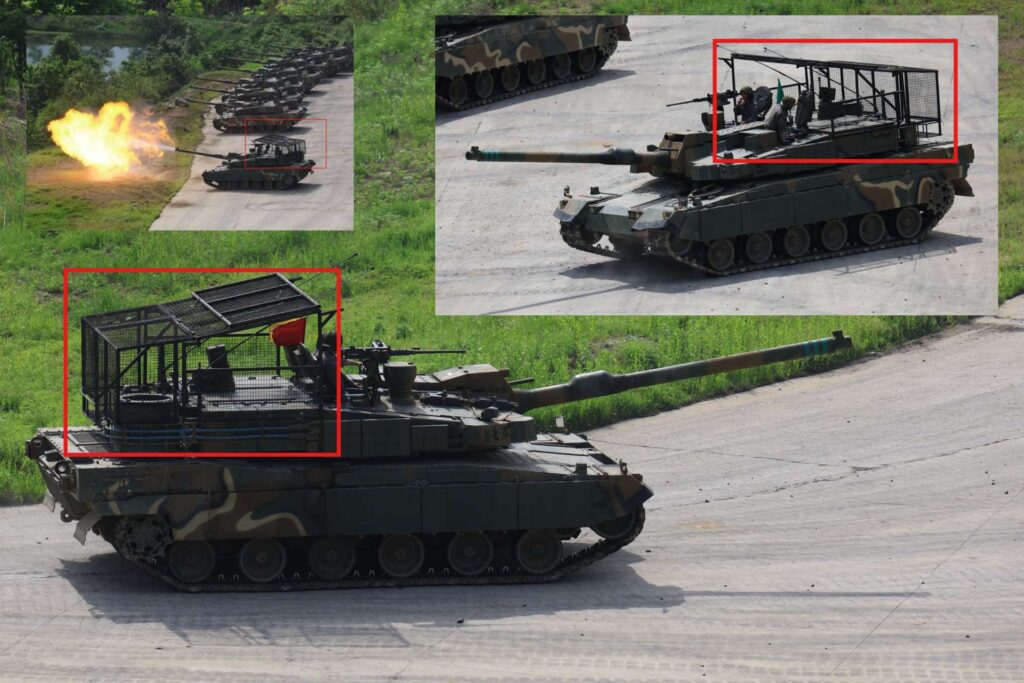
During recent armored training exercises, the South Korean Army conducted live-fire trials of a steel drone defense cage mounted on its K2 Black Panther main battle tank, according to Army Recognition. The tests focused on countering first-person-view suicide drones, weapons that have gained prominence by striking tanks from above, where armor is typically thinner.
Photographs circulating on defense forums show K2 tanks firing their main guns with the cage installed, suggesting that the modification does not interfere with turret movement or core combat functions. The images reflect a broader urgency confronting advanced militaries as drone technology evolves faster than traditional weapons development cycles.
The cage, often referred to as a cope cage, is a steel mesh structure raised over the turret and ammunition storage areas. Rather than attempting to stop an incoming drone outright, it is designed to trigger or deflect the explosive payload before it reaches critical surfaces. The approach mirrors slat armor long used against rocket-propelled grenades, favoring simplicity, speed of installation and low cost over technological elegance.
FPV drones, guided in real time by operators wearing video goggles, have become a defining feature of recent conflicts. Built largely from commercial components, they can be produced cheaply and deployed in large numbers, forcing armies to confront threats that traditional armor was never designed to defeat. Their effectiveness has prompted a reassessment of how tanks can remain viable in increasingly crowded and contested airspace just meters above the ground.
South Korea’s decision to test a cage system illustrates a dilemma facing militaries, including the United States. Advanced solutions such as active protection systems and electronic warfare suites promise more comprehensive defense, but they take years to integrate and field. A steel frame bolted onto an existing tank offers an interim layer of protection against a threat that is already widespread.
Similar protective cages have been fitted to K9 self-propelled howitzers exported by South Korea to Poland, where they were added to improve resilience against unmanned aerial attacks. Extending the concept to the K2 suggests that Seoul is willing to adapt even one of its most advanced armored platforms in response to battlefield lessons emerging abroad.
The trials are part of a broader modernization effort overseen by South Korea’s Defense Acquisition Program Administration, the government agency responsible for military procurement and weapons development. The upgrade program includes plans for an integrated active protection system capable of countering anti-tank missiles and drones, a 360-degree battlefield awareness system to improve crew visibility in complex terrain, and an artificial-intelligence-based remote weapon station to enhance defensive firepower.
Preparations for the program are expected to continue through 2027, with implementation beginning in 2028, signaling that South Korea views the drone threat not as a temporary disruption but as a lasting change in the character of ground warfare.
The steel cage now appearing atop a K2 tank is unlikely to be the final answer to that challenge. Instead, it underscores a broader shift underway as armies confront a future in which adaptability, speed and improvised defenses may matter as much as advanced technology in determining whether heavy armor can survive on the modern battlefield.