South Korea’s global image is moving beyond its pop-culture peak into something more durable, as overseas perceptions of the country climb to their strongest level in years and begin to reflect a broader sense of economic and institutional weight.
A government-backed survey released this week found that 82.3% of respondents across 26 countries held a favorable view of South Korea, the highest level since 2018 and up 3.3 percentage points from a year earlier. The results suggest that what once looked like a cultural wave powered largely by music and television is evolving into a more sustained form of soft power—one that increasingly shapes how the country is positioned in global conversations about industry, lifestyle and governance.
The shift is also exposing a widening perception gap. Foreign audiences now view South Korea more positively than South Koreans view themselves, even after domestic sentiment improved sharply over the past year. The divergence reflects how external observers are increasingly associating the country with cultural sophistication, industrial competitiveness and political resilience, rather than treating it primarily through the lens of regional security risk.
The strongest favorability scores came from the Middle East and parts of Africa, where South Korea has expanded its footprint through energy projects, infrastructure construction, defense exports and technology partnerships. Favorability exceeded 94% in the United Arab Emirates and Egypt, reinforcing the idea that South Korea’s influence in those regions is tied not only to cultural exports but also to its role as a reliable economic and industrial partner.
Europe also showed signs of a recalibration. The U.K. recorded one of the largest year-over-year increases, moving into above-average territory for the first time since the survey began. The shift points to a gradual mainstreaming of South Korea’s brand beyond Asia, as interest broadens from niche cultural appeal to a wider recognition of the country’s economic and societal profile.
In East Asia, sentiment remained more mixed. Favorability toward South Korea in China and Japan continued to trail the global average, though both countries posted meaningful gains. Japan reached its highest level since the survey’s launch, suggesting incremental movement rather than a full reset—but a notable change from the stagnation that marked earlier years.
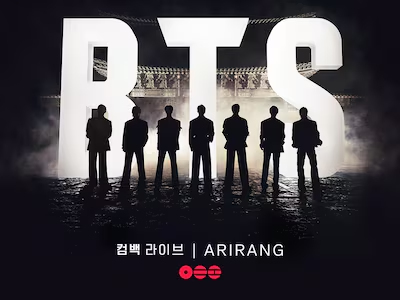
Culture remains the dominant driver of South Korea’s overseas appeal. Nearly half of respondents cited Korean music, television and film as the main reason for their favorable views. Yet the survey indicates that cultural influence is no longer operating in isolation. Modern lifestyle imagery, consumer brands and perceptions of economic sophistication are increasingly reinforcing one another, particularly in regions where Korean companies have expanded manufacturing, construction and technology exports.
The way global audiences consume Korean content is also changing. Video platforms and streaming services now serve as the primary gateway, placing Korean shows and music alongside international competitors rather than separating them as foreign entertainment. That shift has helped normalize South Korea’s presence in everyday media consumption, narrowing the novelty gap that once defined its cultural exports.
Perhaps more striking is how political turbulence has been absorbed into the country’s international image. Interviews conducted alongside the survey found that foreign students, journalists and overseas residents increasingly describe South Korea through a broader frame that includes its political system and civic culture. What might have been viewed externally as instability over the past year was often interpreted instead as evidence of institutional resilience and public engagement, recasting political stress as a feature of democratic maturity rather than weakness.
Taken together, the findings suggest South Korea’s global profile is entering a new phase—one in which cultural influence, industrial capacity and political institutions are seen as mutually reinforcing. The country is no longer evaluated primarily as a cultural phenomenon or a geopolitical flashpoint, but as a multidimensional actor with growing weight in the global order.
Whether that perception endures will depend on how consistently South Korea turns visibility into long-term trust. For now, the numbers indicate that much of the world has already begun to treat the country not as a temporary cultural trend, but as a stable and influential presence on the international stage.