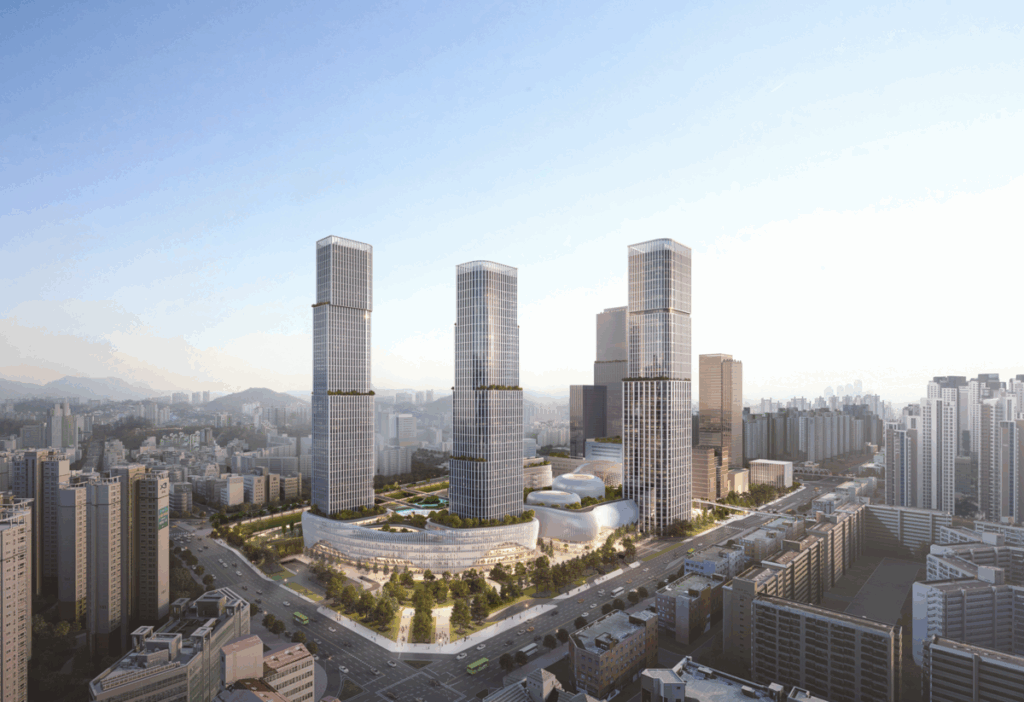
Seoul has begun early-stage negotiations with retail giant Shinsegae Central and Seoul Express Bus Terminal Co. to redevelop the aging Seoul Express Bus Terminal into a massive mixed-use district—an overhaul city planners say could reshape mobility and commerce in Gangnam much like how Hudson Yards transformed Manhattan’s West Side.
The project, spanning roughly 1.57 million square yards, sits atop one of the most important transportation nodes in the capital. The terminal connects to Lines 3, 7, and 9 of the Seoul Metro, making it the only triple-line station south of the Han River. City officials say the site’s connectivity is comparable to hubs like New York’s Penn Station or Chicago’s Union Station, but with far greater potential for vertical redevelopment.
Originally opened in the 1970s alongside the Gyeongbu Expressway, the terminal was once considered a symbol of Korea’s modernization—much like the role Greyhound hubs played for interstate travel in the U.S. By the early 2000s, additions such as Central City brought in hotels, retail malls, and cultural facilities, turning the area into a central commercial district for Gangnam residents.
But its age is now showing. More than half the property is covered by surface parking lots, and chronic congestion caused by hundreds of intercity buses entering and exiting each day has frustrated residents. Pedestrian routes connecting the subway and retail areas remain labyrinth-like—something any visitor to an outdated American mall-station hybrid would immediately recognize.
Under the current proposal, the terminal for major intercity routes—including the Gyeongbu, Yeongdong, and Honam lines—would move underground into a modernized transport hall. Above ground, the developer envisions a soaring 60-story (or taller) tower complex mixing office space, residential units, retail, hospitality, and cultural venues. City officials say the aim is to create a global center of innovation—something akin to combining Boston’s Seaport District with a transit hub like San Francisco’s Salesforce Transit Center.
The proposal also outlines a futuristic mobility network linking the airport, Han River, and nationwide rail lines; a global business hub to attract international firms; and connections to Seoul’s expanding network of green corridors and cultural spaces. An elevated pedestrian bridge connecting the district to the Han River would function similarly to New York’s High Line—but with direct access to the waterfront.
Traffic reform is a major pillar of the redevelopment. Plans call for a dedicated underground bus roadway, redesigned intersections, and a fully separated pedestrian network to eliminate chronic bottlenecks—an issue comparable to the traffic snarls once common at Los Angeles’ Union Station access roads before its modernization.
Seoul officials emphasized that the redevelopment will undergo strict public oversight, including evaluations of potential traffic improvements, community impact, and long-term balance across the city’s major business districts. Once negotiations conclude, the plan will advance through the municipal urban-planning process and move toward construction approvals.
Transforming the Seoul Express Bus Terminal into a vertical megacomplex is “not just a reconstruction project but a reimagining of Seoul’s urban future,” said Lim Chang-soo, the city’s Director of Future Spatial Planning. The site, he added, will become a global mobility hub linking the Gangnam Business District, Yeouido, and Yongsan—Seoul’s closest equivalents to New York’s Midtown, Wall Street, and Hudson Yards.