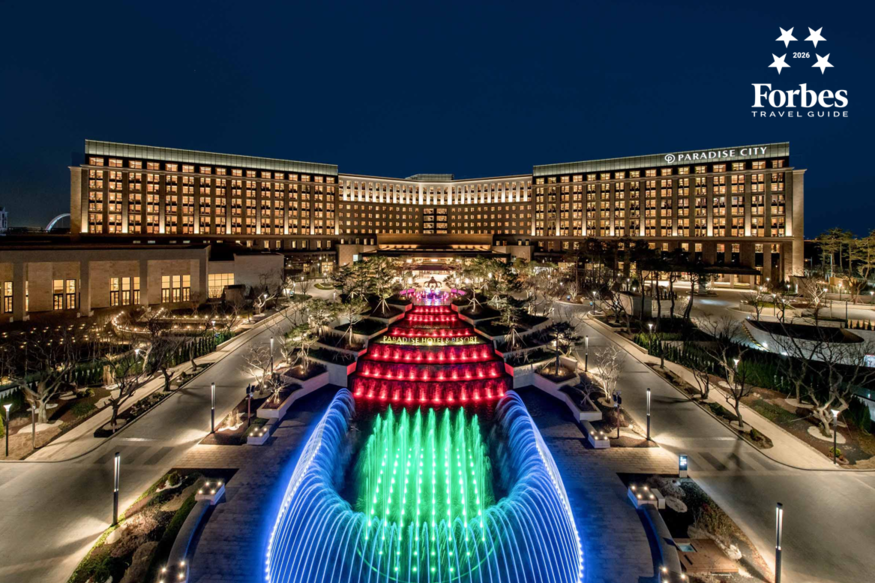
Paradise City’s seventh consecutive Four-Star rating from Forbes Travel Guide is more than a hospitality accolade. For investors watching Asia’s integrated-resort race, it is another data point suggesting South Korea is emerging as a credible operator in a sector long dominated by Macau, Singapore and Las Vegas.
The Incheon-based complex, opened in 2017 near the country’s main international gateway, was designed as a multi-engine property from the start: hotel towers, a foreigner-only casino, convention capacity, retail, destination dining and museum-grade art programming. The strategy aimed to diversify revenue streams and reduce reliance on VIP gaming volatility, a lesson regional operators have absorbed after years of regulatory and travel disruptions.
Forbes’ methodology—built on hundreds of service and facility benchmarks—functions in financial circles as a proxy for execution risk. Maintaining the rating over multiple cycles suggests management systems have matured beyond launch-phase performance, a hurdle that often trips newer resorts once initial curiosity fades.
The recognition arrives as global capital is reassessing where future Asian tourism growth will concentrate. While Macau remains the largest gaming market, investors have become increasingly attentive to jurisdictions that can combine air connectivity, convention traffic and non-gaming attractions with regulatory stability. In that context, proximity to Incheon International Airport has become one of Paradise City’s most marketable assets.
Industry analysts say consistency matters as much as glamour. Integrated resorts require heavy upfront investment and long depreciation schedules, meaning profitability depends on repeat visitation, premium branding and partnerships with travel networks. International certifications help reassure tour operators, event planners and lenders that service delivery will match marketing claims.
Within the complex, the boutique Art Paradiso hotel also retained its Four-Star status and continued to hold the VERIFIED Responsible Hospitality label, which tracks governance and sustainability standards. Environmental and social metrics are becoming more material in financing discussions, particularly for institutional investors with ESG mandates.
South Korea’s ambition in the segment has sometimes been overshadowed by its restrictions on domestic casino play, which limit the immediate scale of gaming revenue. Yet that constraint has pushed operators to cultivate conventions, entertainment programming and lifestyle positioning—areas that can produce steadier long-term returns and align more closely with global tourism trends.
Company officials have said their eventual aim is to climb to the Five-Star tier. From an investment perspective, however, simply sustaining international validation may be equally important. Stability lowers perceived risk, and lower risk can translate into cheaper capital and broader partnership opportunities.
As Asian travel normalizes and governments compete to attract high-spending visitors, Paradise City’s run of ratings suggests the conversation about Korean resorts is shifting—from whether they can enter the league to how far they can advance within it.