Nvidia Chief Executive Jensen Huang on March 16 (local time) praised Samsung Electronics as a key partner in advanced chip manufacturing, signaling a shift in the competitive landscape for artificial intelligence semiconductors.
Speaking at Nvidia’s annual GPU Technology Conference (GTC) 2026, Huang highlighted Samsung’s growing role in producing next-generation AI chips, calling the company “an outstanding partner” during a visit to its exhibition booth.
The endorsement marks a turnaround for Samsung, which had lagged rivals in high-bandwidth memory (HBM) supply just a year earlier. The South Korean tech giant is now gaining traction by combining memory manufacturing with foundry services, positioning itself as a fully integrated semiconductor player.
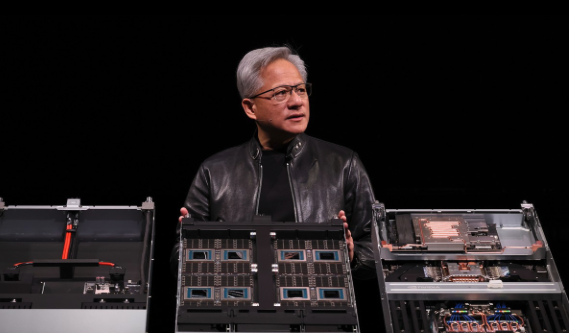
During his keynote, Huang introduced the next-generation language processing unit, Grok 3, and repeatedly thanked Samsung for handling its production. The chip is based on technology from Groq, an AI inference startup Nvidia acquired last year, and is scheduled for shipment in the third quarter.
Nvidia plans to integrate Grok 3 into its upcoming AI accelerator platform, Vera Rubin, pairing graphics processing units (GPUs) for large-scale computation with LPUs for inference tasks to maximize performance. Samsung is also supplying sixth-generation HBM4 memory for the system and unveiled its next-generation HBM4E at the event, signaling deeper collaboration.
Huang underscored surging demand for AI computing, noting that workloads have increased by a factor of 1000000 over the past two years, driven by the rapid growth of AI-native companies such as OpenAI. He projected Nvidia could generate at least $1 trillion in revenue between 2025 and 2027.
He also declared that Moore’s Law, long considered a guiding principle of semiconductor advancement, is losing momentum. Instead, Huang emphasized “accelerated computing” powered by GPUs as the future of the industry.
The conference, running through March 19, features more than 1000 sessions on AI, robotics, autonomous vehicles and semiconductors, and is expected to draw over 30000 attendees from around 190 countries.