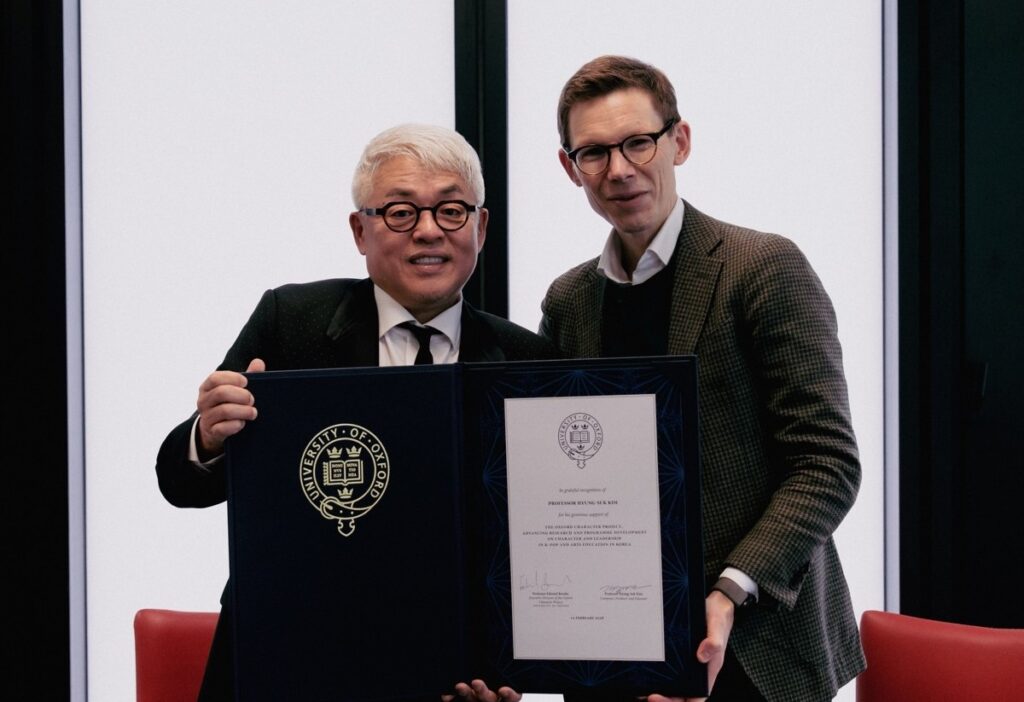
Composer and producer Kim Hyung-seok, best known for shaping some of K-pop’s most enduring ballads, is launching an international school aimed at cultivating arts leaders for the age of artificial intelligence in partnership with the University of Oxford.
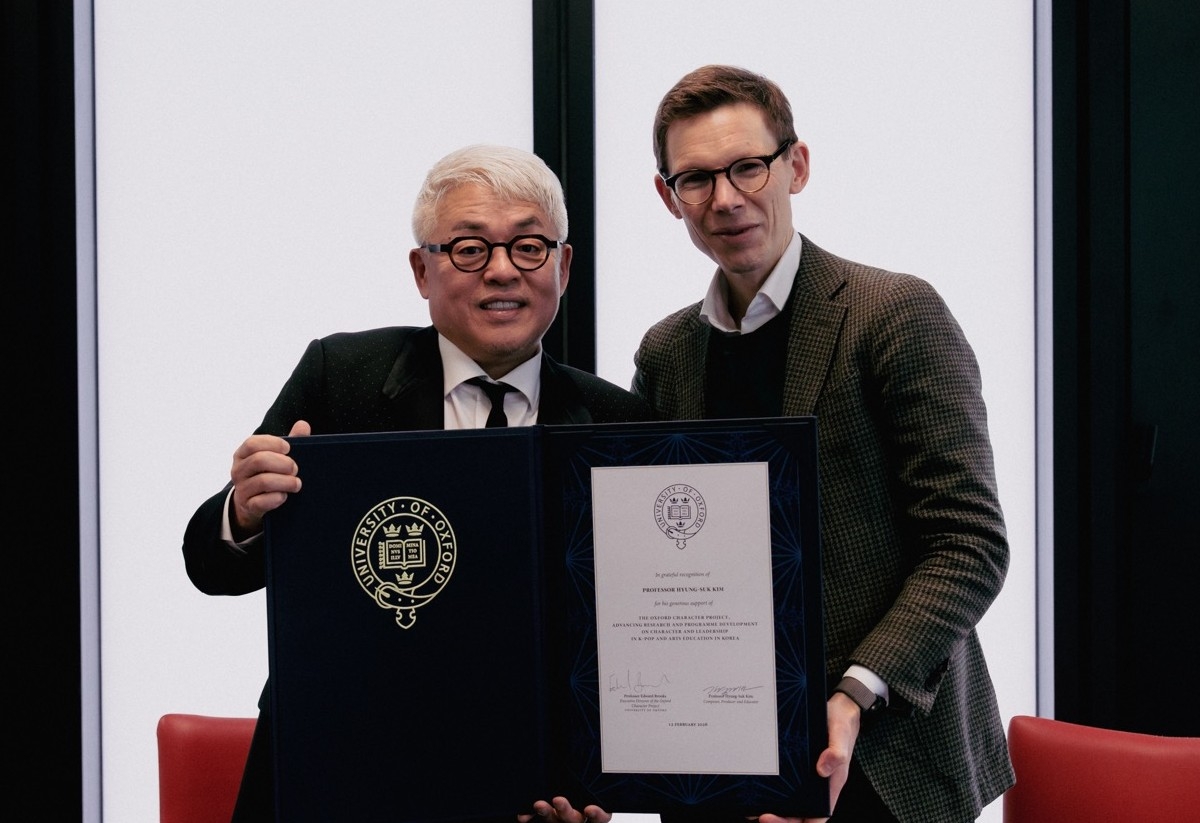
Kim signed an agreement with Oxford’s Character Project, housed within its Department of Politics and International Relations, to support the educational program of the Korean International School of Arts and Sciences, or KISAS, and to collaborate on research into character and leadership in Korean arts education. The agreement was signed on 02/12 local time and announced on 02/19.
Rather than training teenagers to become K-pop idols through intensive singing and dance instruction, the new curriculum is designed to integrate K-culture into a broader liberal-arts framework. Its goal is to foster creative leaders and artists grounded in character, ethics and intellectual depth.
The Oxford Character Project, led by Professor Edward Brooks, focuses on cultivating virtues such as purpose, resilience, empathy and responsibility. Brooks said the joint curriculum would be structured to ensure that artistic excellence is reinforced by reflection on these traits.
“In a global environment shaped by digital transformation and heightened public visibility, technical proficiency alone is not enough,” Brooks said. “Young creators must also develop the wisdom and authenticity required to exercise cultural influence responsibly.”
Kim, often dubbed a “hitmaker” in South Korea, composed classics including “Because of Love” for Kim Kwang-seokand “I Believe” for Shin Seung-hun, and contributed to the soundtrack of the television drama All In. In 2024, he granted Oxford permission to use more than 1,400 of his songs in its Korean-language program and has since served as a visiting researcher, deepening his ties with the university.
Kim said his pivot toward education was driven by concerns about the sustainability of K-pop’s global dominance in an era when AI tools can generate songs in seconds. “Beyond K-pop, what comes next? In a time when AI is changing every paradigm, what should we teach the next generation?” he said. “In the AI era, the essential question is ‘Who am I, and what will I do?’ That requires the integration of the arts, humanities and philosophy.”
Under the agreement, the partners will develop a primary- and secondary-school curriculum that combines creative arts education rooted in the Korean Wave with character and leadership training. The program will be used at KISAS in South Korea, while Oxford plans to host tailored summer camps offering certificates to participating students.
Kim said he is considering both building KISAS as a new standalone institution and embedding its curriculum within existing international schools in South Korea.
Looking ahead, the two sides are exploring ways to create a globally adaptable model that could be distributed on a noncommercial basis to countries in the Global South. They also plan to expand cooperation in research on cultural leadership and public engagement.
Brooks described K-culture as “already a form of global leadership,” noting that its artists shape identities and values across borders. The partnership, he said, aims to bring greater academic depth to one of the most influential cultural movements of the era.