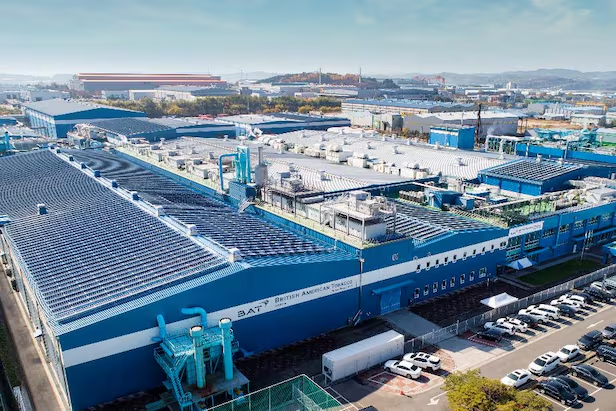
From the vantage point of U.S. manufacturers grappling with drought, regulation and climate risk, a factory in southern South Korea offers a glimpse of where industrial water management may be heading.
A plant operated by British American Tobacco has become the first manufacturing facility in South Korea to earn the highest certification from the Alliance for Water Stewardship, an international body that evaluates how companies manage water not only within their gates but across entire local watersheds.
The Platinum rating, awarded to BAT Korea Manufacturing’s facility in Sacheon, places the site in a small global cohort of plants that meet AWS’s most demanding standards. Those standards go beyond compliance with local rules, focusing instead on long-term water security, advanced treatment systems and sustained engagement with surrounding communities that share the same water resources.
For observers accustomed to viewing South Korea primarily through the lens of semiconductors, shipbuilding and heavy industry, the milestone is notable. It underscores how water—long treated as a background input to manufacturing—is emerging as a strategic operational issue even in countries not typically associated with acute scarcity.
According to BAT, the Sacheon plant treats and reuses roughly 60,000 metric tons of wastewater a year, sharply reducing its dependence on external supplies and minimizing discharge into nearby waterways. The facility also works with local governments and public agencies on water-quality monitoring, pollution-response drills and flood-prevention planning, reflecting AWS’s emphasis on managing shared risk rather than optimizing a single site in isolation.
The Platinum designation caps a multi-year process. The plant first achieved AWS’s entry-level Core certification in 2022, then expanded its water governance systems and stakeholder engagement to meet progressively higher benchmarks. AWS assessments examine not just pipes and treatment units, but whether companies account for the social and environmental consequences of industrial water use in the regions where they operate.
Executives at the plant say the recognition reflects a broader shift in how global manufacturers are approaching water—especially in areas where factories sit alongside residential neighborhoods and farmland. Rather than treating water as a utility cost, the company has framed it as a shared asset requiring coordination with local authorities and communities.
The Sacheon facility, opened in 2002, was the first manufacturing plant built in South Korea by a global tobacco company. Today it operates within BAT’s wider sustainability framework, which includes reducing carbon emissions, improving energy efficiency and managing environmental risk across its global production network.
For U.S. companies watching from afar, the lesson is less about tobacco than about trajectory. As climate volatility intensifies and regulators scrutinize industrial water use more closely, practices once seen as voluntary or reputational are increasingly becoming central to operational resilience. South Korea’s first AWS Platinum plant suggests that the bar for global manufacturing is rising—and that water stewardship is fast becoming a competitive differentiator rather than a peripheral concern.