
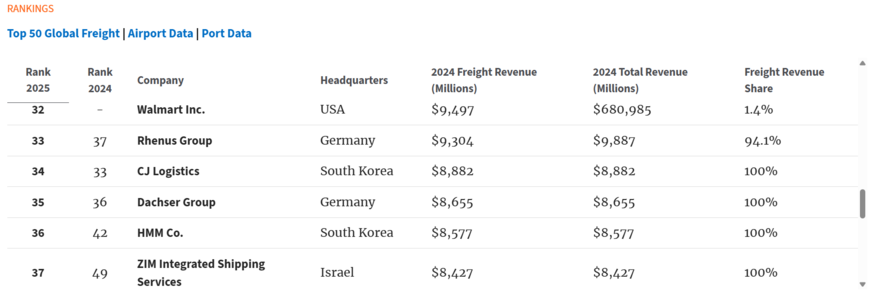
The South Korean firm’s 34th-place ranking highlights a strategic pivot toward integrated services, even as the industry giants pull further ahead with scale and vertical integration.
In a global freight industry increasingly defined by colossal scale and vertical integration, South Korea’s CJ Logistics has carved out a notable position, ranking 34th in a closely watched list of the world’s top transport companies. The placement, the highest for any Korean firm, underscores a deliberate shift beyond traditional shipping toward a more resilient, service-driven model in the face of dominance by e-commerce and parcel giants.
The 2025 Top 50 Global Freight Companies ranking, released by the industry publication Transport Topics, placed CJ Logistics just ahead of compatriot shipping line HMM, which ranked 36th. The list is led by Amazon, with a staggering $156.1 billion in freight revenue—a testament to its sprawling, captive logistics network—followed by UPS, FedEx, and DHL Group.
For CJ Logistics, the ranking validates a multiyear strategy to diversify away from pure transportation. By building out its contract logistics, e-commerce fulfillment, and cross-border solution segments, the company has sought to create a more stable revenue base less susceptible to the volatile freight-rate swings that buffet traditional carriers.
“The race is no longer just about moving containers or parcels; it’s about managing and optimizing the entire supply chain for clients,” said Lee Min-kyu, a logistics analyst at Seoul-based Meritz Securities. “CJ’s ranking reflects its successful, if gradual, pivot from an asset-heavy transporter to a solutions provider. But the gap between the top five and the rest of the field is becoming a chasm.”
Indeed, the landscape reveals a tale of two industries. At the top, companies like Amazon and the integrated express carriers operate vast, capital-intensive networks that blend physical infrastructure with data dominance. Further down the list, competition is fierce among ocean carriers, freight forwarders, and third-party logistics (3PL) firms like CJ Logistics, all vying for relevance in a sector being reshaped by digital demands and sustainability pressures.
HMM’s presence at 36th, up six spots from the prior year despite a turbulent container market, highlights the persistent importance of scale in global shipping, even as the industry consolidates. Yet, for both Korean companies, the rankings underscore a broader challenge: maintaining growth and influence amid the overwhelming capital and technological firepower of the American and European leaders.
Analysts say the future competitive edge will hinge less on sheer size and more on technological agility, customized service offerings, and seamless cross-border capabilities. “Scale alone is not a defensible moat anymore,” noted global supply chain advisor James Lee. “The winners will be those who can combine operational efficiency with intelligent, data-driven solutions for specific trade lanes and industry verticals.”
In response to these shifts, CJ Logistics has signaled plans to accelerate investment in overseas logistics hubs, automation, and digital platforms. The company aims to deepen its integration into the global e-commerce ecosystem and strengthen its contract logistics portfolio, betting that flexibility and specialization will allow it to compete in pockets of opportunity against the industry’s titans.
The presence of two Korean companies in the top 50 serves as a barometer of the nation’s continued logistics prowess. However, it also frames a critical strategic question for its champions: in an era of giants, is there a sustainable path to growth that doesn’t require becoming one?