A South Korean food company is reimagining one of Asia’s oldest eating utensils as a piece of consumer technology, betting that dining in the U.S. is increasingly shaped by screens as much as by taste.
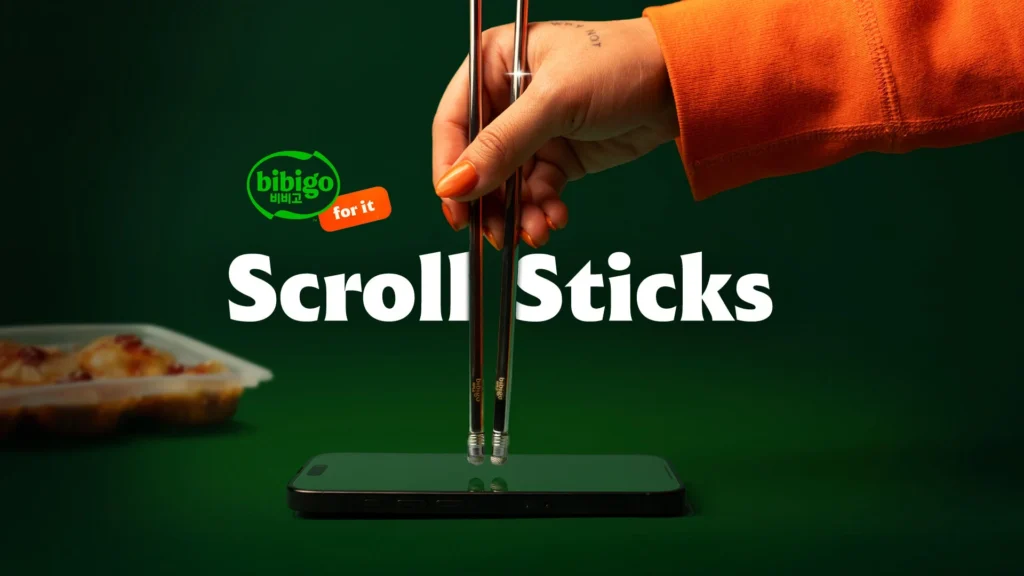
CJ CheilJedang, the parent of the Bibigo brand, has introduced a limited-edition product called ScrollSticks—chopsticks fitted with a detachable touchscreen tip that allows users to operate smartphones while eating. The concept underscores a growing convergence between everyday consumption and digital behavior, as companies look for ways to embed their brands deeper into daily routines.
The idea is rooted in shifting habits. In a survey conducted with Angus Reid, 96% of U.S. respondents said they use smartphones while eating, and 66% reported doing so at least once a day. Nearly three-quarters cited inconveniences such as greasy fingers and smudged screens when switching between food and devices, pointing to a small but persistent friction in screen-centric lifestyles.
ScrollSticks reframes that friction as a product opportunity. By integrating basic touchscreen functionality into chopsticks, CJ CheilJedang is effectively redesigning the dining interface for a generation accustomed to uninterrupted scrolling. The move suggests that even routine activities such as eating are being reengineered around digital continuity.
For the company, the initiative is less about hardware sales than about strategic positioning. Bibigo has already established a strong foothold in U.S. retail, particularly in frozen foods, where its dumplings have become a staple in mainstream grocery chains. A tech-enabled utensil extends that presence beyond the freezer aisle, positioning the brand at the intersection of food, devices and content consumption.
Executives describe the effort as part of a broader “food-tech” or “food-tainment” strategy, in which food is integrated with entertainment and digital engagement. Earlier concepts, such as in-vehicle “dashboard kitchen” setups designed for content creation, reflect a wider ambition to align food consumption with evolving media habits rather than treating them as separate experiences.
The timing reflects a broader shift in how products gain traction. In an attention-driven economy, particularly among younger consumers, usability and shareability can rival flavor as drivers of demand. Food items increasingly double as content, circulating through short-form video platforms where presentation and interaction shape visibility.
By merging chopsticks with touchscreen functionality, CJ CheilJedang is testing whether even the most traditional elements of dining can be adapted to a screen-first culture. The bet is that convenience at the intersection of food and technology may scale as effectively as taste itself.
More broadly, the move highlights a changing competitive landscape for global food brands. As Korean cuisine expands its reach, differentiation may depend not only on what consumers eat, but on how seamlessly those products integrate into digitally mediated lifestyles.