
Submarines have long been something of an afterthought in Canadian national defense policy. In the 1960s, they simply leased some from the U.S navy, before acquiring outdated Oberon-class vessels from the U.K. to maintain a bare-minimum capability.
However, the situation changed fast – Russia and China are assertively expanding their presence in the Arctic while the security umbrella formed with the U.S. began wavering. Now, even for the Canadians, submarines are no longer a good-to-have but a must-have for survival.
The CPSP(Canadian Patrol Submarine Project), the single largest procurement in the history of the Canadian navy, marks a pivotal shift – Canada has effectively declared submarines are at the core of the national defense strategy, not on the periphery.
Korea and Germany are the two remaining competitors, locked in a fierce head-to-head for the massive contract. Each side presented proposals beyond the joint national security, to a wide range of industrial cooperation spanning mining, energy and automotives.
The game is in effect a lot more than a security deal – it is a nation-to-nation pact. The Guru traveled to Canada where the final decision is soon to be made, to capture the tension on the ground – Editor’s Note
The Naval Association of Canada(NAC) boasts a century-long history. It is primarily staffed by veterans, who are mostly committed to voicing for the Navy. In the CPSP project, they played essential roles as an advisor and a communication channel bridging government, navy and civil enterprises.
Tim Addison is leading the Ottawa branch, after serving the Navy for 35 years. A two-time Gulf War veteran, he held senior leadership roles within the National Defense Ministry. Now an independent consultant, he continues to provide valuable advice regarding defense policies in general.
Q. Could you tell us more about the NAC?
NAC is a nationwide organization with about 800 members. There once were 14 branches, but they now have been reduced to 8. Here at the Ottawa branch, we host about 300 active members.
The Canadian Navy has long struggled to convince the general public on why we needed a larger defense budget and to construct new, powerful vessels, and how such a movement would strategically benefit not only the security but also the economy. NAC has taken up the part of advocating for the importance of the Navy.
Our efforts span various activities. For example, we support the Canadian War Museum every year by maintaining the exhibits and other naval monuments. We publish a series of magazines called Starshell where our opinions are printed and take wings.
Q. Why is the CPSP project so critical for Canada?
Submarines allow easier control over specific maritime zones. They can effectively block incursions by enemy submarines or surface ships once they secure chokepoints. With that in mind, we can deploy them on the paths to the Strait of Juan de Fuca or Prince Rupert. There are other considerations, too, in case of disputes on the eastern coast. Submarines are indispensable for us.
The global climate crisis gave us renewed accessibility to the Arctic. This is an important development when considering that Russia is increasing its activities in the region and the northern coast, while China is expanding its presence. Mere deployment of submarines in some points will serve as a powerful deterrent.
Q. Canada is looking to procure 12 submarines. What is the reasoning behind this number?
To maintain a constant presence of 1 to 2 submarines in the Arctic and Asia-Pacific for weeks at a time, we need a sustainable deployment cycle. While one vessel is on mission, others must undergo crew training and maintenance. Therefore, 12 is the bare minimum. Ideally, 16 would be better, as it would allow us to keep one submarine on each coast at all times while having a third or fourth ready for additional operations.
Q. How would you evaluate Hanwha and ThyssenKrupp Marine Systems (TKMS)?
Both companies are formidable contenders. They both meet our requirements in terms of delivering the capabilities Canada needs. However, Canada will likely require some degree of customization after the initial purchase. While we prefer “off-the-shelf” products, specific equipment must be added depending on the mission area. Both firms must demonstrate the flexibility to accommodate these modifications.
Q. Why is the Arctic so vital to Canada, and what specific specs are needed for operations there?
The Arctic is a unique environment that we must protect—not just to prevent the depletion of fish stocks, but also to secure vast mineral deposits. Preserving these resources until a future decision on extraction is made is a matter of Canadian sovereignty. As Vice Admiral Angus Topshee mentioned, “under-ice capability” is a prerequisite. This requires specialized sonar equipment to detect the underside of ice formations and avoid collisions.
Q. What level of economic cooperation is the Canadian government expecting?
The scope is quite broad, centered on the Industrial and Technological Benefits (ITB) policy where the money we spend returns to Canada through jobs or investment. This could be directly related to the submarine project—such as using Algoma Steel for the hull—or indirect, like creating jobs in maintenance firms or investing in R&D. For instance, Canada has critical minerals, but we haven’t fully mapped their potential applications. A company supporting research into these minerals as part of their bid would offer a massive benefit to Canada.
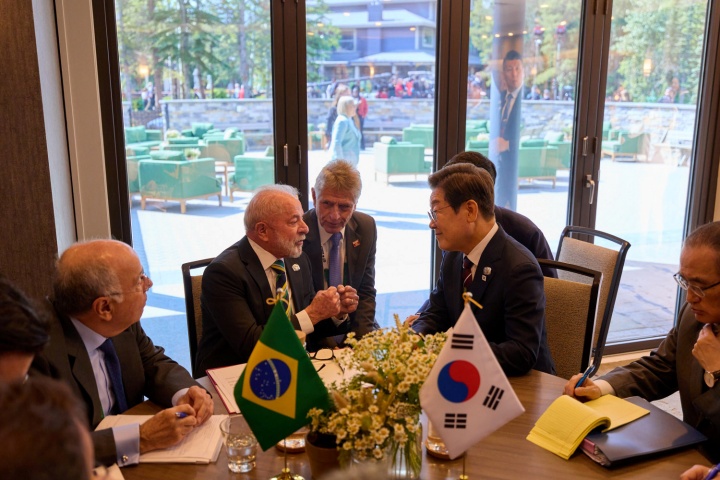
Q. A South Korean presidential envoy recently visited Canada to propose economic cooperation. How is this being perceived locally?
The opportunities for bilateral business cooperation are limitless. One thing to keep in mind is that Canada is actively trying to reduce its trade dependency on the U.S. While we trust the U.S. as an ally, we no longer feel entirely comfortable relying solely on them. Consequently, Canada is eager to expand trade globally, particularly with partners in Asia and Europe.